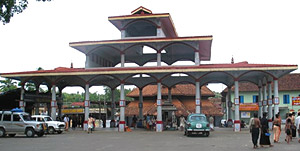
 Features of architecture in Kerala reflect their aesthetic aim of monumental stability. The Keralite temples are an amalgamation of wood work, stone work, stucco work which is cordially blended into a structure vivacious with traditions of the regions. Subtle architectural insights back up the taste in creating the impression of an architecture that is quite organic to the soil. Some of the features of architecture of Kerala are as follows -
Circular Design
In terms of architectural style, there are many temples in Kerala that belong to the Dravidian tradition which is a common legacy of the peninsular south. But the truly indigenous contribution is the circular temple. The shape refers to the main edifice and the sanctum is most often square. In addition to the temples built upon the square or rectangular plan, which is the layout to which the Dravidian temple generally conforms, circular temples are also discussed in the traditional texts of Indian architecture. However, very few of them are found today. The circle, square and rectangle are archetypal shapes of construction. But the fact that circular buildings are set up by some of the primitive peoples of Kerala is quite significant.
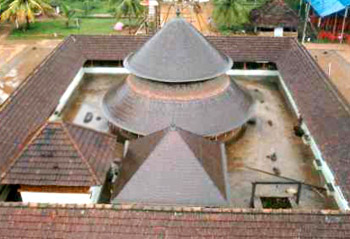
Subtle architectural devices have been used to reinforce the modest proportions to stress the aesthetic impression of man`s creation. The symmetry of the circle does not hamper fine nuances and modulations. A conical roof is the most satisfying logical solution for the enclosure built on a circular layout. The sixteenth-century Ettumanoor temple is a fine illustration. Its central shrine is circular in shape and it is surmounted by a conical roof. This is covered with copper plates. The tenth-century temple at Thrikkotithanam has a double conical roof. The ridge of the roof, especially if made of light wood, has a tendency to relax its linear rigour and produce a slightly concave skyline, another feature which has echoes in Nepalese tradition.
 The sanctum, circular in the indigenous tradition, square or oblong in the Dravidian tradition becomes a self-sufficient design for small shrines. Growth in complexity of design is a logical extension of the basic layout. The path becomes enclosed by a wall, then by a walled colonnade. This develops an outer portico to house the altar, with sometimes a flag-staff in front of it. The outer wall of the colonnade carries row after row, in neat alignments, of small lamps fixed in a wooden frame-work over the masonry base. On the outside of the whole structure there may be a paved processional path. In the larger temples, there is a separate edifice for sacred recitals and dance-drama. The grounds are enclosed by a compound wall, which may develop into walled corridors. Many of the older and larger temples in Kerala have a sacred wood which, in spite of its small area, has the lush growth of trees that once covered most of Kerala and which were gradually cleared over the centuries for human settlement. This development of structural complexity is managed without ostentation. Most of the temples is richly decorated with sculpture and painting.
Domestic type of Architecture
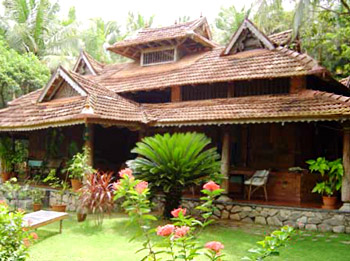
The concept of the module in both its old and new meanings seems to have been known to the architectural tradition in Kerala. It stands revealed with particular clarity in domestic architecture. A module means, with reference to classical European architecture, a small unit of measure. In the layout of the age-old domestic architecture of Kerala, the courtyard corresponds to the patio of Spanish architecture. The traditional Kerala house is a quadrangular building called Nalukettu constructed strictly in accordance with the principles of Tachu Sastra (Science of Architecture). The whole layout is thus flexible and ideally suited for the joint family of the old days because of its capacity for repetition and extension. The wooden walls of the old houses had narrow slits which admitted air and made the whole interior feel like a cool, light, airy, wide basket. It may also be noted that the old palaces of Kerala represent the style of traditional domestic architecture. The most important palaces that deserve mention are the Padmanabhapuram Palace, the Dutch Palace at Mattancheri and the Krishnapuram Palace near Kayamkulam.
An interesting blending of indigenous and foreign architectural styles, the latter mainly of the basilican pattern, is seen in Kerala churches. There are also several ancient mosques in Kerala built in the indigenous architectural style.