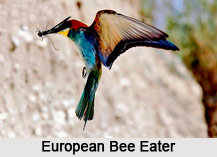
 European Bee-Eater is an Indian bird that bears a scientific name "Merops apiaster", is a slender looking bird, concentrated in the Europe, Eurasia and the other parts of the world.
Breeding of European Bee-Eater
European Bee-Eater is a near passerine bird in the bee-eater family Meropidae. It breeds in southern Europe and in parts of North Africa and Western Asia.
Migration of European Bee-Eater
European Bee-Eater is strongly migratory, wintering in tropical Africa, India and Sri Lanka. This species occurs as a spring overshoot north of its range, with occasional breeding in northwest Europe.
Structure of European Bee-Eater
European Bee-Eater is like other bee-eaters, is a richly-coloured, slender bird. It has brown and yellow upper parts, whilst the wings are green and the beak is black. It can reach a length of 27-29 cm (10.6-11.4 in), including the two elongated central tail feathers. Sexes are alike.
Breeding Time of European Bee-Eater
European Bee-Eater breeds in open country in warmer climates. As the name suggests, Bee-Eaters predominantly eat insects, especially bees, wasps, and hornets. They catch insects in flight, in sorties from an open perch. Before eating a bee, the European bee-eater removes the sting by repeatedly hitting the insect on a hard surface. It can eat around 250 bees a day.
Behaviour of European Bee-Eater
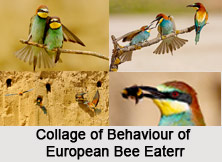
European Bee-Eater is gregarious in nature. European Bee-Eaters have a nesting colonially in sandy banks, preferably near river shores, usually at the beginning of May. They make a relatively long tunnel, in which they lay five to eight spherical white eggs around the beginning of June. They also feed and roost communally.
Courtship of European Bee-Eater
During courtship, the male European Bee-Eater feeds large items to the female while eating the small ones himself. Most males are monogamous, but occasional bigamy has been encountered. Their typical call is a distinctive, mellow, liquid and burry prreee or prruup.
 Nests of European Bee-Eater
European Bee-Eaters have the breeding areas frequents river valleys, pastures, cultivated areas with some trees, meadows and plains, hillsides, riverbanks with shrub in semi-desert, and also corn-oak and olive-tree plantations, rice fields and cereal crops. In Africa, on their wintering areas, these birds frequent savannahs, lake shores and cultivated areas.
Feeding of European Bee-Eater
European Bee-Eater feeds primarily on bees, wasps, hornets and similar species. It catches them on the wing, performing sallies from exposed perches. Before swallowing the prey, the Bee-Eater strikes it against a hard surface in order to remove the sting. One single bird may eat up to 250 bees per day.
Prey by European Bee-Eater
European Bee-Eater also catches other insects such as dragonflies, butterflies, cicadas, termites and grasshoppers. The prey is caught after a short chase in flight from tree, wire or fence, and brought back to the perch to envenom it.