
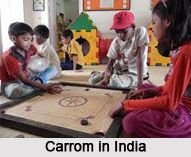
 Carrom in India is a popular indoor club and house game for a long time that lies somewhere between table shuffleboard and billiards. The game of carrom is believed to have originated from the Indian subcontinent. Although no concrete evidence is available, it is believed that the Indian Maharajas invented the carrom. One Carrom Board with its surface made of glass is still available in one of the palaces in Patiala, Punjab.
Carrom in India
Carrom in India has come a long way and is now a popular game played both as pastime and for competition games. This game in India is now popular as an indoor and club game.
Introduction
Carrom in India is a popular indoor club and house game for a long time that lies somewhere between table shuffleboard and billiards. The game of carrom is believed to have originated from the Indian subcontinent. Although no concrete evidence is available, it is believed that the Indian Maharajas invented the carrom. One Carrom Board with its surface made of glass is still available in one of the palaces in Patiala, Punjab.Naming of Carrom in India
This indoor game is known by many names around the world like carrum, couronne, carum, karam, karom, karum, fatta (Punjabi) and finger billiards.
History of Carrom in India
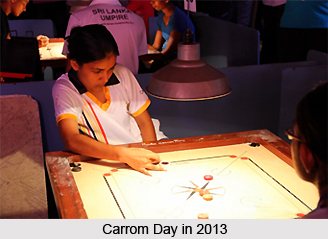 History of Carrom in India goes back a long way to the 18th century. Although there are no solid evidences available, but mostly it is believed that the game originated in Indian sub-continent. In the ancient times Maharajas played this game in their palaces. One such carrom board with surface made of glass is still available in a palace in Patiala. Particularly after World War I this game became very popular. Different states hosted various state level competitions during the initial part of 19th century. This game, which was once treated as a simple game meant for pastime, is now being played by almost 20 million people in India alone.
Carrom is a popular indoor game in India and like Badminton, Hockey and Polo in India, carrom too was little known in the West. But with change in times, carrom now has huge takers in the Western countries as well. With each passing day the game is gaining huge popularity all around the globe and is now being played in almost 50 countries. This game, at the international level, is supervised and controlled by the International Carrom Federation.
Carrom is a popular game in India and is no longer limited to ladies and children, and is now played at competitive levels. The game required complete knowledge of deftness of touch, angles and control over nerves. It is mainly based on geometry and physics. It also requires deep concentration and skill.
In India the game is controlled and promoted by All India Carrom Federation, where around 48 units (30 State Associations and 18 Institutions), affiliated to the former, are supervising carom activities in India through hundreds of District Associations and their office network in case of Institutions. Already this federation has organized 117 national championships and many other tournaments. The Carrom game in India is organized by Government of India and State Governments, and is treated at par with other games in India. The government of India allots grant-in-aid for national carom championships. The central government, in 1991, included carom in its lists for the purpose of recruitment under sports quota in government organizations. As a result of this policy, carom players are getting recruited for the jobs in Government offices and Public Sector Undertakings under sports quota. This game also allows students to get admitted to various degree courses at various state government sponsored colleges. The School Games Federation of India recognized it in 1996. The Indian Olympic Association has also recognized this game.
Around 1930 Carrom competitions started in cities like Chennai, Kolkata, Delhi and Allahabad. `Union Carrom Club of Almora` came into existence in 1932 whose President was Rai Bahadur H.K. Gangola. These games were organized much before the formation of the Federation, so the rules differed with each game. The boards used during this period were also of different shapes and sizes. Many carrom boards even had pockets inside the frame of the board like Billiards. States like West Bengal and Bihar had boards with triangular pockets. The board size varied from 32" and 54" square. The game was played with 12 black and 12 white carrom men with no queen. Later of course it was increased to 25 with one queen, but no control over the weight and size of carrom men (Cm). Different point rules were followed at different places. The strikers of any shape, size, weight and fabric like plastic, ebonite, vulcanite, etc. were being used. Ivory made strikers were also used by elite class. This of course stopped once a fixed rule was formulated by the federation.
Forms of Carrom
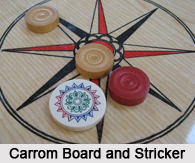 Carrom is various forms are played in numerous countries across the world, both for fun and as a competitive game. This game requires simple equipments helping in larger player base. There also exist variants of carrom that employ cue sticks.
Gaining Popularity of Carrom
Carrom game is very popular in India, and also in other nations like; Bangladesh, Sri Lanka, Nepal and Pakistan. Apart from these counties, Carrom is played in other parts of the world as well.
Equipments of Carrom
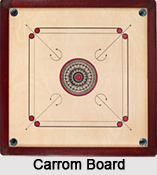 Equipments of Carrom in India contain mainly eight items, which assists in the play.
Carrom in India is a very popular sport. Previously it used to be regarded as an indoor game only, but now it is played at various competitive levels in India and around the world.
Carrom in India is played on a square board made of lacquered plywood in India, with dimension of 29 inches or 74 cm. the bottom surface of the playing board is covered by net which is 10 cm long or more and the edges are bounded bumpers of wood. In the game of carrom the players use disks and not balls. The main objective is to use the striker and with a flick of finger make contact with the lighter object known as carrom men, which are thus propelled into one of four corner pockets.
Standard equipments used to play carrom are as follows:
 Carrom Board
Carrommen
Striker
Stand or Table
Stool or Chair
Powder
Nets
Light
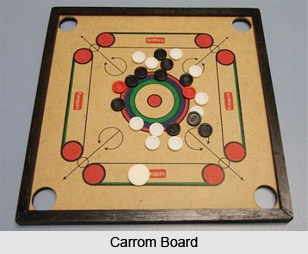
Carrom Board : Playing surface of the Carrom Board (CB) should be of plywood or made out of birch wood or any other good wood with thickness not less than 8 mm. The size of the board is 73.66 cm (29 in) square. A Carrom Board shall be able to have at least three and a half runs of a normally smooth striker made of ivory when struck with the maximum possible force from one of the base lines to the opposite frame of the Carrom Board.
Adjoining the playing surface, there shall be wooden frame with good resistance with height not less than 1.90 cm and not more than 2.54 cm with inside curved corners. The breadth should be 6.35 cm and by no way more than 7.60 cm. the board should have pockets at the four corners which shall be round inwardly and be of 4.45 cm diameters, with nets underneath.
Queen : The red disk is called the queen. The queen is the most powerful carrom piece. During board setup, it is placed at the centre of the circle. In accordance with the Inetrnational Carrom Federation rules, pocketing the queen adds 3 points to the player`s total score. The dimensions of the queen must be the same as those of other carrom men.
Carrom men : Carrom game is played on the board using even, small disks of wood or sometimes plastic, called carrom men (also carrom men, carrom men). It is often abbreviated as c/m, and colloquially known as coin, puck, goti or seed. Carrom men have a level position on the surface of the carrom board when hit by a striker of standard specification.
These carrom men are of three different colours. Two colours are used to specify individual team or opponents. These colours are black and white. Red is a special colour that designates the queen.
ICF approved pieces must have a diameter of no more than 3.18 cm and no less than 3.02 cm. The pieces must be at least 7 mm and at most 9 mm thick. The pieces have a plain, rounded edge. The mass of the pieces is within 5 g and 5.5 g.
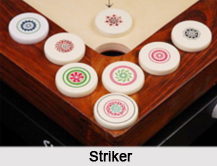
Striker : This is an important equipment needed for playing carrom and should be round and smooth and not more than 4.13 cm and should not weigh more than 15.00 gm. A Striker is made of special plastic. It is not made of ivory, as was the norm during the initial days when the game first came into being. Striker made of metal and visible to the eye, shall not be allowed as well, but decent designs engraved on it is permissible. It is heavier and larger than carrom men. According to ICF rules, "the striker is smooth and round, with a diameter that does not exceed 4.13 cm."
Stand and Table : Stand and table on which carrom board are placed should not be less than 63.00 cm and not more than 70.00 cm. The board when placed on it should not be shaky and uneven. However, in many cases, padding is also used below the carrom board to make it level and firm as far as possible.
Stool or Chair : Chair or stool on which a player sits for playing should not be less than 40.00 cm and also not more than 50.00 cm in height. In case chairs are used they should be armless.
Powder : Powder is used in a carrom board to keep the playing surface dry and smooth. But the powder should not be wet. Containers and pouches filled with powder should be spread evenly across the board surface.
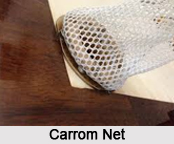
Nets : The nets are used to cover the pockets from beneath and it is fixed at the bottom of the Carrom Board. Each net should have the capacity of holding at least 10 C/m
Light : Bulb, preferably transparent white between 60 and 100 watts, should placed be at a convenient height above the centre position. Two, three or four people can play.
Rules of Carrom
 Rules of Carrom are universally followed all around the world. Previously when the game was first discovered, people played the game making their own set of laws. Carrom is found throughout the Eastern part of the world under different names though most non-eastern people know it by the East Asian name of Carroms. Carrom is very popular in Nepal, India, Pakistan, Bangladesh, Sri Lanka and surrounding areas and in the Middle East as well. But once the All India Carrom Federation (AICF) came into existence in 1956, it put forward certain specific rules and regulation for the game. Some of the universally acclaimed rules of carrom in India are as follows:
Singles in Carrom : In singles, the players shall sit opposite to each other. In doubles four persons comprising two teams, the partners shall sit opposite to each other, occupying all four sides.
Arranging of Rows in Carrom : Before the break, Carrom men are arranged in the inner circle with the queen (red) always occupying the centre circle and the rest placed around; keeping the white and black alternately.
Second Row in Carrom : In the second row of Carrom, three white carrom men will form the shape of Y` with the white carrom men of the first row. The remaining space is filled up by placing white and black alternately.
Break in Carrom : Break is taken by a player who has chosen to strike first. The player, who is to break, will have whites on the board. The queen shall be common. Winner of the toss has the option to choose side or to break.
Striker of Carrom : Even if the striker touches slightly any carrom man, it is considered that the break has been made. The two trial boards are played before a match. A player`s turn will continue, as long as he pockets his own carrom men and/or queen according to the law. Black and white carrom men change in alternate boards both for singles and doubles. However, in the second game the player who did not have his first turn in the first game shall have his first turn. Each carrom man has one point if pocketed by the striker. Queen value is three and value of the queen for a player is lost if he reaches 22. A game shall be of 25 points. A player who scores 25 wins the game. All matches are decided by the best of three games. Each game consists of eight boards or 25 points whichever is earlier. A player leading at the end of the eighth board will be the winner. In the case of a tie at the end of the 8th board, 9th board will be played as a tie breaker.
Third Game in Carrom : In the third game the players shall change sides after reaching 13 points or after completion of the fourth board whichever is earlier. This is applicable till pre-quarter final stage. From quarter-final onwards, change of side takes place after a player scores 13 points irrespective of the number of boards.
Scoring the Queen in Carrom : The player can pocket the queen and cover it, provided one C/M of his own has already been pocketed and is not brought out as due or penalty in the stroke. If the queen is pocketed before any C/M of the player is pocketed, the queen will be taken out for placing on the CB. If the queen is not covered it will be taken out. If the queen and one C/M of the player are pocketed together in one stroke, the queen is covered. When all nine C/Ms are on the CB, and queen and one C/M are pocketed then the queen is not covered. If the queen, a C/M and the striker are pocketed together, they and an additional C/M will be taken out; the player will continue his turn. When all nine C/Ms are on the CB, and the queen and striker are pocketed together, the queen will be replaced, a due will be declared. The player will lose his turn. The player can pocket the C/M together with his striker while covering the queen. The C/M plus one will be taken out. The player shall continue his turn. If subsequently he cannot pocket any C/M, the queen will be taken out for placing.
If the queen along with the last C/M of the player and the opponent are pocketed together, the queen is scored. If the queen is on the CB and the player pockets the remaining C/M of the opponent, he will lose the Board by the number of his C/Ms plus the points of the queen. If the queen is on the CB and the player pockets the last of his and the opponent`s C/M, he loses the Board by three points. If while covering the queen, the C/M of his own and his opponent`s are pocketed together, he wins by three points or "I" point if score is 22 or more. If the player pockets all his C/Ms leaving the queen on the Board, the opponent will win the Board by three points. If the player pockets the queen and the last C/M of his opponent while covering pockets, he shall lose the Board by the number of his C/Ms on the Board plus the points of the queen. If the player pockets the last C/M of his own together with the striker leaving the queen on Board, he loses the Board by three points. If the player pockets the queen, his last C/M, opponent`s last C/M and the striker together, he loses the Board by three points. If the player pockets his and his opponent`s last C/M along with the striker, he will lose the Board by one point, if the queen has already been covered by him or by three points if the queen has been covered by his opponent.
Role of All India Carrom Federation
In India, carrom game is promoted and patronized by All India Carrom Federation (AICF). This association was formed on 4th March in the year 1956 with, Chennai, Mumbai, Delhi, Saurashtra, Hyderabad and Madhya Pradesh as its affiliated units. The sports council of Government of India recognized AICF in the year 1970, and since then the federation is getting regular grants and aids from the Indian government.
International Carrom Federation
International Carrom Federation (ICF) is the international governing body for the game of carrom. International Carrom Federation (ICF) was first proposed in the 1950s. The delegates from India, Sri Lanka, the Maldives, Malaysia, Germany and Switzerland met in Madras, where formed International Carrom Federation.
Recently updated articles in Traditional Sports in India

Abhinav Singh Bindra
Abhinav Singh Bindra is an Indian Olympic champion and former professional shooter who made history by winning India’s first individual Olympic gold m...
Raja-Rani Game
Raja-Rani is a traditional Indian sport widely played in the South Indian states. This fun game is influenced by the characters of Ramayana. The game...
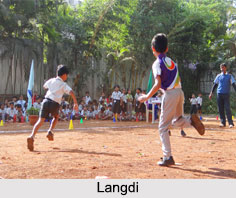
Langdi
Langdi is a traditional Indian field game which is similar to Hopscotch. The game has been included as regular game in Mumbai University. Played on on...

Hardeep Singh - Indian Wrestler
Hardeep Singh is an Indian wrestler and he is a Greco-Roman wrestler haling from Haryana.
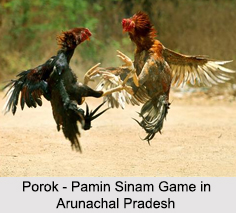
Traditional Sports of Arunachal Pradesh
There are numerous traditional sports in Arunachal Pradesh, which are played with equal enthusiasm by the native people of the state.
Related articles in Traditional Sports in India
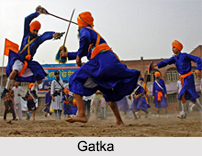
Gatka
Gatka is an ancient martial art developed to defend and display fighting skills and to better exercise self control.
Thoda
It is a martial form of Himachal Pradesh, practised by bows and arrows.
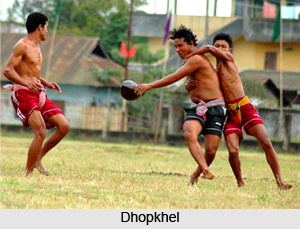
Dhopkhel
Dhopkhel is a very famous indigenous game of the Assamese. A rubber ball is used to play Dhopkhel and the players need great speed and other athletic...
Traditional Games
Apart from the other famous traditional games, these other regional games have also been a part of our Indian culture.
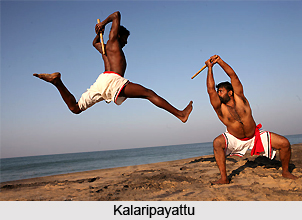
Kalaripayattu Martial Art
Kalaripayattu is an ancient form of martial art training and discipline of Kerala, which has its root back to the 12th century.