 Eastern Great Egret is an Indian bird with a scientific name "Ardea alba modesta", a white heron in the genus Ardea, is a subspecies of the great egret (A. alba). It was first described by British ornithologist John Edward Gray in 1831.Although a study argued for full species status in 2005 most taxonomists consider it to be a subspecies.
Structure of Eastern Great Egret
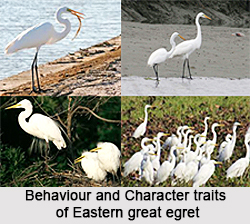
Eastern Great Egret is measuring about 83 to 103 cm in length and weighing 0.7-1.2 kg (1.5-2.6 lb). Eastern Great Egret is a large heron with all-white plumage.
Bills of Eastern Great Egret
The bill of Eastern Great Egret is yellow in the breeding season and black at other times, and its long legs are red or black.
Colour of Eastern Great Egret
The colours of the bare parts change during the breeding season. The breeding plumage is also marked by long neck plumes and a green facial area.
Concentration of Eastern Great Egret
Eastern Great Egret can be distinguished from other white egrets and herons in Asia and Australia by its very long neck, one and a half times as long as its own body. Eastern great egret has a wide distribution throughout Asia and Oceania, with breeding populations in Pakistan, India, Sri Lanka, Bangladesh, Burma, Thailand, China, Korea, north-eastern Russia, Japan, Indochina, Indonesia, Papua New Guinea, the Solomon Islands, Australia, and New Zealand. The egret breeds across Australia but only rarely in the southwest of the continent or dry interior.
Feedings of Eastern Great Egret
The diet of Eastern Great Egret includes vertebrates such as fish, frogs, small reptiles, small birds and rodents, and invertebrates such as insects, crustaceans, and molluscs. The eastern great egret hunts by wading or standing still in shallow water and "spearing" prey with its bill.
Breeding of Eastern Great Egret
Eastern Great Egret often breeds in colonies with other herons, egrets, cormorants, spoonbills and ibises. One brood is raised a year, although the breeding season varies within Australia. In the north of the country it is in March to May, in southern and central Queensland December and January, and October to December in the south. Located atop trees at a height of 20 m (60 ft) or more, the nest is a flat wide platform of dry branches and sticks with a shallow basin for eggs and young. The clutch consists of anywhere from two to six pale blue-green eggs, with three or four being the usual number. They are oval in shape and measure 52 X 36 mm.