
The twenty-third yoga sutra explains about the consciousness realising its own true nature, that it is not the reflector or all-pervading. In reality, these functions are covered by the seer. The consciousness, in juxtaposition with both the seer and the seen, thinks itself as wholly omniscient and tangible. However, a wise yogi will understand that it does not have an identity of its own, but acts under the seer. He tries to keep it from impurities of the seen. In such cases, the reflection is never distorted.
drastr the knower, the seer
driya the knowable, the seen
uparaktam coloured, reflected, tainted, afflicted
cittam consciousness
sarvartham all-pervading, cognizing, comprehending, apprehending
Consciousness, reflected by the seer as well as by the seen, appears to be all-comprehending.
Consciousness, being in conjunction both with the seer and the seen, appears to an average individual to be all pervading, omniscient and real. When one is cultured and purified, one realises that consciousness has no existence of its own but is dependent on the seer.
As the physical frame is the body of consciousness, therefore consciousness is the body of the seer. Consciousness is the bridge between nature and soul, and its conjunction is either illumined by the seer or tainted by the seen. The wise yogi frees consciousness from the qualities of nature; he keeps it clean, so that it is reflected without distortion both by the seer and the seen. When the waves of the sea subside, they lose their identities and become the sea. In the same way, when the waves of the seer - the senses of perception, mind, intelligence and consciousness - subside, they lose their identities and merge in the ocean of the seer, for the seer to blaze forth independently. This is the sight of the soul.
For a clearer understanding of consciousness, one can refer to sutras iv.22-25 as a group.
In iv.22, Patanjali explains that consciousness is no longer a subject but an object. It is not a knower but the known. As it is trained by sadhana towards maturity (paripakva citta), it gains purity (suddha citta) through pure intelligence (iuddha buddhi).
Until now, consciousness was under the impression that it was the reflector (bimba) and all other images were its reflected reflections (pratibvhba). This sutra explains that consciousness in its immature state takes itself to be all-powerful and all-pervading, but the truth is that the seer is actually the reflector. Patanjali illustrates that the impersonating consciousness is transformed to the level of the seen, so that both the reflector and its reflection, gitta, are identical.
It is said in the Bhagavad Gita (vi.19) that as a lamp in a windless place does not flicker, so the sheaths of a cultured yogi do not shake. They remain untouched by the wind of desires for the seer to reflect his own glorious light, atmajyoti, and to dwell in that light - purusa jnana.
Drastr drsya uparaktam cittam sarvartham
This is the twenty-third yogic sutra, which is incorporated in the fourth phase of the Patanjali Yoga Sutra.
Recently updated articles in Yoga
Khanda Manda Yoga
Khanda Manda Yoga is a difficult form of yoga where the Yogi cuts off his own arms and legs with a sharp cleaver, that is axe-like knife, and throws t...
Kaivalya Pada
Kaivalya Pada, the fourth chapter of Patanjali Yoga Sutra denotes an absolute, indivisible state of existence of the Yogi. The Kaivalya Pada is someti...
Vibhuti Pada
Vibhuti is the Sanskrit term for “power” or “manifestation.” In this third chapter, Patanjali introduces the final three limbs of Aṣṭanga Yoga, collec...
Sadhana Pada
Sadhana Pada in Patanjali Yoga Sutra denotes the idea of practicing yoga that leads to spiritual illumination. Sadhana, the Sanskrit term for “practic...
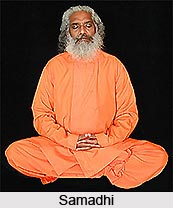
Samadhi Pada
Samadhi Pada is the first chapter of Patanjali Yoga Sutra. In this chapter, the author explains the essence of yoga, the nature of samadhi, and the me...
Related articles in Yoga
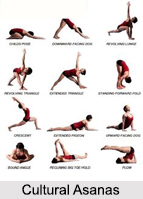
Cultural Asanas
Cultural Asanas refer to the daily physical exercise postures that train the body and mind in Yoga Practice.
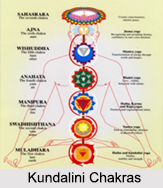
Kundalini Chakras
Kundalini Chakras are psychic energy centres or vortices, which connect between our psychic and physical energy systems.
Patanjali Yoga Sutras
Patanjali’s Yoga Sutras presents a foundational guide to the philosophy and practice of yoga. Through concise aphorisms, it outlines the nature of the...
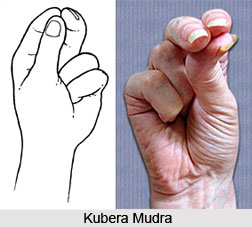
Kubera Mudra
Kubera Mudra, a form of Hatha Yoga, leads to the elevation of mental peace and physical relief by proper practice and cleanses frontal sinuses.