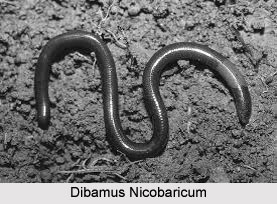
 Dibamus Nicobaricum is an Indian Reptile from the lizard family, Dibamus nicobaricum is widely found in the dense forests of Andaman and Nicobar Islands. Rhinophidion nicobarium, Typhloscincus nicobaricum, Dibamus nicobaricum, Dibamus nicobaricum, Dibamus nicobaricus, Dibamus nicobaricum and Dibamus nicobaricus are the common scientific names of Dibamus nicobaricum.
History of Dibamus Nicobaricum
The genus Dibamus was last reviewed by Greer (1985), when it contained nine nominal species. At present, there are 15 nominal species, in addition to at least two unnamed populations in West Malaysia. Dibamus alfredi was described by Taylor (1962) from "NaPradoo, Pattani, Thailand at base of Bukit Besar". In a subsequent work, Taylor mentioned that an earlier record by Tweedie of Dibamus novaeguineae from the limestone outcrop of Gua Madu, adjacent to the town of Gua Musang, Kelantan State, Peninsular Malaysia, might refer to this species. Dibamus alfredi was confirmed from extreme southern Thailand, as well as the island of Nias, off the west coast of Sumatra and from Danum Valley in Sabah State, East Malaysia, leaving an apparent hiatus in the distribution of the species in Peninsular Malaysia. Denzer and Manthey, while remarking that Tweedie"s material needed re-evaluation, identified the specimen from Gua Madu as D. Novaeguineae, following the concept of Smith who referred nearly all species then known to this species.
Snout of Dibamus Nicobaricum
The snout of Dibamus nicobaricum is conical, obtuse, and slightly projecting.
Shields of Dibamus Nicobaricum
Dibamus Nicobaricum has four enlarged shields on the head besides the rostral and labial scales - a frontal, an interparietal, and an ocular on each side; the interparietal shield is the largest.
Eyes of Dibamus Nicobaricum
The eyes of Dibamus Nicobaricum are scarcely distinguishable through the ocular scale.
Sublabial of Dibamus Nicobaricum
Dibamus Nicobaricum has a narrow, elongate, trapezoidal mental and a very large sublabial on each side.
Scales of Dibamus Nicobaricum
The scales of Dibamus Nicobaricum are equal. It is about 22 to 26 round the middle of the body.
Preanal Scales of Dibamus Nicobaricum
The preanal scales of Dibamus Nicobaricum are very small.
Tail of Dibamus Nicobaricum
The tail of Dibamus Nicobaricum is very short and obtuse.
Body of Dibamus Nicobaricum
The body of Dibamus Nicobaricum is a uniform purplish-brown colour.
Length of Dibamus Nicobaricum
The Total body and tail length of Dibamus Nicobaricum is five to eight inches.
Habitat of Dibamus Nicobaricum
Dibamus Nicobaricum is found on Great Nicobar Island, Andaman and Nicobar Island, Ross Island and the Indira Point region and probably Little Nicobar Island also. The type locality is given as "Nicobar Islands".