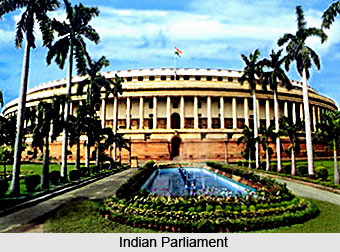
Introduction
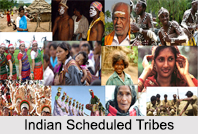
Indian Scheduled Tribes are the group of tribal communities and was given the name "Scheduled Tribes" during the post-Independence period, under the rule of Indian Constitution. Since the Independence of India, the Scheduled Tribes were given Reservation status. India can proudly be called the largest tribal population in the world. The scheduled tribes in India constituted 8.2 percent of India"s population, according to 2011 census. In all, 698 scheduled tribes exist at present in India.
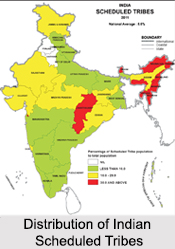
The primary criteria adopted for delimiting Indian backward communities as Scheduled Tribes includes, traditional occupation of a definitive geographical area, characteristic culture that includes a whole range of tribal modes of life, i.e., language, customs, traditions, religious beliefs, arts and crafts, etc., archaic traits portraying occupational pattern, economy, etc., and lack of educational and economic development. The people in scheduled castes are essentially the lowest part of Hindu society.
Origin of Indian Scheduled Tribes
Scheduled Tribes in India, also referred to as Adivasis (original inhabitants), are spread all-over India. These various tribes resided in India long before the Aryans had arrived roughly during 1500 B.C.
Society of Indian Scheduled Tribes
More than 650 tribes that make up the Scheduled Tribes speak a multitude of languages. They are also religiously diverse, with some following animism, while others have adopted Hinduism, Islam or Christianity. The social traditions of most tribals make them stand out from the country"s mainstream Hindu population.
Revolutions of Indian Scheduled Tribes
The Indian scheduled tribes collectively owned property in keeping with their tradition. The colonial authorities had introduced a land administration where others infringed into traditional tribal lands on the grounds that such lands were "Terra Nullius" meaning "no man"s land". This led to a series of tribal revolts against British colonial rule. And these tribal revolts have been legendary in Indian history, referring to the Malpahariya uprising in 1772, the turbulence in Kutch in 1815 and 1832, the Bhil revolt of 1818, the uprising of the Mers in Rajputana in 1820, the rebellion of the Hos in Chota Nagpur in 1831, the uprising of the Khonds in Odisha in 1846 and the Santhal rebellion in Bihar in 1855. Heroes like Birsa Munda, Kanhu Santhal and Tantya Bhil stand out valiantly in the chronicles of Indian nationalism.
Developmental Plans for Indian Scheduled Tribes
The word "Scheduled Tribe" is an administrative coinage, used for purposes of giving out constitutional privileges, security and benefits in independent India. The first pre-requisite of Indian Scheduled Tribes in relation to a particular State or Union Territory is through a notified order of the President, after consultation with the concerned State Government. These orders can be modified consequently only through an Act of Parliament.
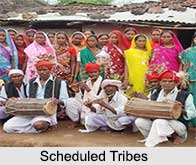
The 5th and 6th Schedules under Article 244 of Indian Constitution in 1950 provided for self-governance in particular tribal majority areas. The then governmental administration issued a draft National Policy on Tribals in 1999 to meet the developmental needs of tribal populations, including the scheduled tribes. Prominence was laid on education, forestry, health care, land rights, language policy and resettlement. Efforts were also made to differentiate tribal languages such as Bodo language, Gond language and Santhali language. The then Government had established a Ministry of Tribal Affairs. It designated out the states of Chhattisgarh and Jharkhand in acknowledgment of tribal sentiment. The subsequent governmental administration drafted the controversial Scheduled Tribes (Recognition of Forest Rights) Bill in 2005 to deal with their needs.
Different Scheduled Tribes in India
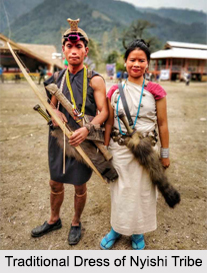
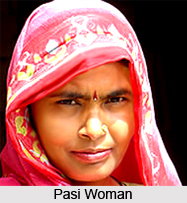
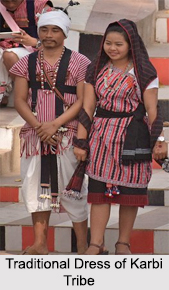
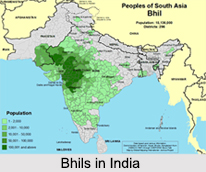
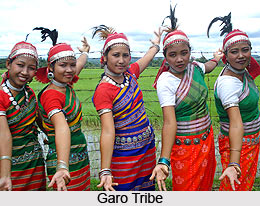
Indian Scheduled Tribes account for 55 percent of the total displaced population in India. Some of the noted Scheduled Tribes in India comprise: Andamanese, Bodo, Garo, Bhil, Chakma, Dhodia Tribes of Gujarat, Gonds, Khasis, aboriginal tribe of Lakshadweep, Kurichiya, Kurumba, Toda, Tripuri, Mizos, Kharia, Mundaris, Ulladan, Naga Tribe, Nicobarese, Oraon, Santhal, Todas, Dhanwar, Pao, Maldharis of Gujarat, Cholanaikkan, Warli, Kisan Tribe, Dongria Kondh, Lepcha, Bhutia, Birhor, Subba, Bonda, Kutia Kondh, Bishapus A`Mishapus, Jatapus, Konda Kapus, Kotia, Abor, Phake, Baiga, Velip, Chamar and many others.
Along with being geographically and socially isolated, the tribal groups have historically been politically under-represented. Their regions of residence also have been economically underdeveloped. Scheduled tribe status under the Indian Constitution has designated reserved seats for tribals in political forums, such as the Parliament, along with job reservations in the civil service and educational institutions.
Development of Scheduled Tribes in India
Scheduled Tribes (STs) are spread across the forest and hilly regions of India like Madhya Pradesh, Maharashtra, Odisha, Bihar, Andhra Pradesh, West Bengal and Gujarat. The crucial features of these communities are ancient characteristics, geographical separation, idiosyncratic culture, timidity of contact.
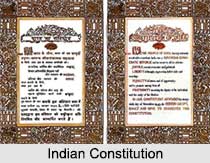
Indian Constitution and Development of Scheduled Tribes
The founders of Indian constitution were responsive of their problems and made special conditions for their fortification and improvement. The main safeguards of Scheduled Tribes include the sponsorship of educational and economic interests and their security from social injustices and all forms of development. The constitution presents special representation for the STs in the Lok Sabha and State legislative assemblies till 25th January, 2010 and commands the setting up of separate departments in the States and National Commission at the Centre to help their welfare. Later on with a view to successfully deal with the crimes against the Scheduled Tribes, two special laws "Protection of Civil Rights Act 1955" and the "Scheduled Castes, Scheduled Tribes (Prevention of Atrocities) Act 1989" were passed.
Special economic development of the Scheduled Tribes and protection against their exploitation has been an important programme of the Government. To certify that the legitimate mandates, high precedence for the welfare and development of Scheduled Tribes right from the beginning of the First Five Year Plan is being on agreement. Recognising their special problems the principles of "Panchsheel" have been adopted in the welfare and development of these communities. An essential landmark was opening of 43 Special Multipurpose Tribal Blocks (SMPTBs) in the Second Five Year Plan, later called Tribal Development Blocks (TDBs). Further, an important step in this bearing was taken in the Fourth Five Year Plan when six pilot projects in Andhra Pradesh, Bihar, Madhya Pradesh and Odisha were set up in the Central sector. A separate Tribal Development Agency was established for each project. The Commissions and Committees selected by the Government to check the tribal state of affairs brought to its notice that the percolation theory had not helped the tribal population.
The Tribal Sub-Plans for Scheduled Tribes
The Fifth Five Year Plan marked a move when the Tribal Sub Plan (TSP) for the direct advantage of the STs was launched. The Tribal Sub-Plan for the Scheduled Tribes was designed to channelize the flow of expends and benefits from the general sectors in the plans of the States and Union Territories (UTs) and Central Ministries in amount to their population. It is mainly an area development curriculum with focus on tribal under which infrastructural development and family- oriented programmes are undertaken.
The Ministry of Tribal Affairs is a preservative to the Tribal Sub Plan of the States and UTs and grants under Article 275 (1) of the Constitution for raising the level of infrastructure in the Scheduled Areas and economic development of the Scheduled Tribes. It is also executing different Centrally-sponsored and Central sector schemes under which monetary assistance is given to the States and UTs for the construction of hostels and coaching of ST students for competitive examinations and the development of their worth, research and training, setting up of ashram schools, professional training centres, village grain banks, educational complexes for ST girls and the development of primitive tribal groups. Besides this, non-governmental organisations (NGOs) have also been involved in the development of STs.
With the main purpose of providing marketing support and remunerative prices to the tribal population for their minor forest produce (MFP) and surplus agricultural produce (SAP) and to wean them away from exploitative private traders, the Tribal Cooperative Marketing Development Federation (TRIFED) was set up by the Government in the year 1987. The Government is working hard towards a new social order based on social equality and social harmony.
Constitutional Remedies for Scheduled Tribes
Following are the different Constitutional Remedies for the Scheduled Tribes:
• Article 330 of the Indian Constitution states the Reservation of seats for Scheduled Castes and Scheduled Tribes in the House of the People.
• Article 332 of the Indian Constitution states the Reservation of seats for Scheduled Castes and Scheduled Tribes in the Legislative Assemblies of the States.
• Article 334 of the Indian Constitution states the Reservation of seats and special representation to cease after sixty years.
• Article 243D of the Indian Constitution states the Reservation of seats (in Panchayats).
• Article 164(1) provides that in the States of Chhattisgarh, Jharkhand, Madhya Pradesh and Odisha there shall be a Minister in charge of tribal welfare who may in addition be in charge of the welfare of the Scheduled Castes and backward classes or any other work.
• Article 371A has special provisions with respect to the State of Nagaland.
• Article 371B has special provisions with respect to the State of Assam.
• Article 371C has special provisions with respect to the State of Manipur.
• Article 371F has special provisions with respect to Sikkim.
Education of Scheduled Tribes
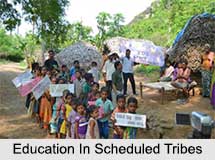
Education in the tribal areas is about informing the Scheduled Tribes and communities about the new innovations in science and technology as well as the development in economic and political fields. Thus education should be productive to the tribal people for the improvement of social and economic position.
Constitutional Provisions of Education in Scheduled Tribes
Understanding the significance of education, the Indian constitution has made specific provisions in Article 15(iv) and 46 for promoting education among the scheduled tribes. According to 1981 census, the literacy among the scheduled tribes was 14.58 percent against the general literacy of 31.34 percent. The rate of tribal literacy varies from region to region. There are some important causes for slow-progress in literacy among the tribes. Such causes are as follows.
Problems of Education in Scheduled Tribes
Following are the different problems faced by the Scheduled Tribes people in receiving education:
Lack of Interest in Formal Education
In many states the tribal children are taught with the same books and the content of such books appeals the tribal children who come from different cultural backgrounds. Stories of scientific and technological progress, founders of modern India, history and geography of the country should be taught. National awareness should not be imposed from above or outside, but they should be made aware of it in a systematic method.
Lack of Facilities
Nature of habitat of tribes is also responsible for the slow growth of education. Most of the tribal villages are scattered. This entails long travels to attend schools. School builds in some cases, also plays an important role in the growth of education among the tribal folk. Government planners observe education as essential for helping tribal people to cope with the national incorporation. The Constitution of India, under Article 350A, affirms that every state must provide adequate facilities for instruction of pupils in their mother tongue.
Content and Method of Tribal Education
Tribal youth have exclusive historical and social backgrounds but need special attention and orientation. Many school and college curriculum are either inappropriate to them or offer only negative views of tribal societies. While national and state governments, in theory, offer many benefits, concessions and facilities to tribal students, few of them reach the intended recipients.
National Commission for Scheduled Tribes
The National Commission for Scheduled Tribes (NCST) was formed by improving Article 338 and adopting a new Article 338A in the Constitution. This amendment, replaced the previous National Commission for Scheduled Castes and Scheduled Tribes, and formed 2 distinct Commissions, National Commission for Scheduled Tribes (NCST) and National Commission for Scheduled Castes (NCSC), from February, 2004. Certain Communities in the nation were suffering from various Economic and Social problems, like untouchability, old agricultural practices, lack of infrastructure facilities and geographical isolation etc. thus in order to protect their interests, these communities were identified as Scheduled Tribes and Scheduled Castes according to the provisions mentioned in Clause 1 of Articles 341 and 342 of the Indian Constitution. In the year 1978, the Indian Govt. established a Non-Statutory Commission for SCs and STs and appointed Bhola Paswan Shastri as the Chairperson along with 4 other Members.
Article 338A of the Constitution provides for a National Commission for Scheduled Tribes-
(1) There shall be a Commission for the Scheduled Tribes to be known as the National Commission for the Scheduled Tribes.
(2) Subject to the provisions of any law made in this behalf by Parliament, the Commission shall consist of a Chairperson, Vice- Chairperson and 3 other Members and the conditions of service and tenure of office of the Chairperson, Vice-Chairperson and other Members so appointed shall be such as the President by rule determine.
(3) The Chairperson, Vice-Chairperson and other Members of the Commission shall be appointed by the President by warrant under his hand and seal.
(4) The Commission shall have the power to regulate its own procedure.
(5) Duty of the Commission-
* To investigate and monitor all matters relating to the safeguards provided for the Scheduled Tribes under this Constitution or under any other law for the time being in force or under any order of the Government and to evaluate the working of such safeguards;
* To inquire into specific complaints with respect to the deprivation of rights and safeguards of the Scheduled Tribes;
* To participate and advise on the planning process of socio-economic development of the Scheduled Tribes and to evaluate the progress of their development under the Union and any State;
* To present to the President, annually and at such other times as the Commission may deem fit, reports upon the working of those safeguards;
* To make in such reports recommendations as to the measures that should be taken by the Union or any State for the effective implementation of those safeguards and other measures for the protection, welfare and socio-economic development of the Scheduled Tribes; and
* To discharge such other functions in relation to the protection, welfare and development and advancement of the Scheduled Tribes as the President may, subject to the provisions of any law made by Parliament, by rule specify.
(6) The President shall cause all such reports to be laid before each House of Parliament along with a memorandum explaining the action taken or proposed to be taken on the recommendations relating to the Union and the reasons for the non-acceptance, if any, of any such recommendations.
(7) Where any such report, or any part thereof, relates to any matter with which any State Government is concerned, a copy of such report shall be forward ed to the Governor of the State who shall cause it to be laid before the Legislature of the State along with a memorandum explaining the action taken or proposed to be taken on the recommendations relating to the State and the reasons for the non-acceptance, if any, of any of such recommendations.
(8) The Commission shall, while investigating any matter referred to in sub-clause (a) or inquiring into any complaint referred to in sub-clause (b) of clause (5), have all the powers of a civil court trying a suit and in particular in respect of the following matters, namely,
(a) Summoning and enforcing the attendance of any person from any part of India and examining him on oath;
(b) Requiring the discovery and production of any document;
(c) Receiving evidence on affidavits;
(d) Requisitioning any public record or copy thereof from any court or office;
(e) Issuing commissions for the examination of witnesses and documents;
(f) Any other matter which the President may, by rule, determine.
(9) The Union and every State Government shall consult the Commission on all major policy matters affecting Scheduled Tribes.
Powers of National Commission for Scheduled Tribes : Under Clause (8) of Article 338A, the Commission is vested with certain powers of a Civil Court, for inquiry and investigations. The National Commission for Scheduled Tribes has the following authorities:
* Summon and enforce attendance of any individual and examine on oath;
* Detection and production of any documents;
* Receive evidence on affidavits;
* Requisition any Public Record or copy from any court or office;
* Issue Commissions for examination of witnesses and documents; and
* Any matter which President, may determine, by rule.
Union and every State Government are adviced to consult the Commission on all key Policy matters that might affect the Scheduled Tribes.