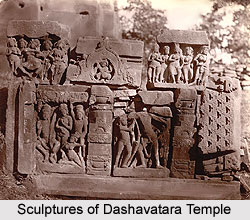
Sculptures of Dashavatara Temple can be viewed on the terraced basement, with imprinted collectibles of river goddesses
Ganga and
Yamuna beside the doorway to the sanctum sanctorum. On the side walls, in addition to all the architectural works, three large carved panels of
Vaishnava mythology related to
Gajendra Moksham, the Nara Narayana Tapasya (meditation), and the Sheshashayi Vishnu (reclining on the serpent), are portrayed. A defensive wall that is made of undressed stone was constructed around the temple after it was first discovered. However, the idol of the sanctum sanctorum of the temple is missing, believed to have been relocated somewhere else.
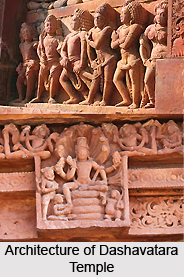
In the innovative and massive sculptor of Sheshashayi Vishnu, Lord Vishnu is projected reclining on the serpent Shesha, with four-arms lying down on the spiral of a snake with seven hoods, forming a shade over his crowned head. Vishnu`s consort, goddess
Lakshmi, along with her two attendants, is at Vishnu`s feet. Other gods and celestials are also seen inspecting this display. Another panel below this, Madhu and Kaitabha (two demons) are also getting ready to attack. They are viewed to be repulsed by four personified weapons or ayudhapurushas of Lord Vishnu. As per another understanding, the lower panel portrays the five
Pandavas and
Draupadi, their wife.
The assistance of the doorway (Lalatabhimba in Sanskrit) of temple also projects Lord Vishnu seated on Shesha the serpent, with Lakshmi sitting down and caressing his feet, flanked by two incarnations of Lord Vishnu: Narasimha (the man-lion form) on the right, and Vamana (the dwarf form) on the left.
The back and side walls of the temple shows carved panels related to many facets of the life of Lord Vishnu. On the Northern Walls, the beautifully crafted panel depicts "Gajendra Moksha" that represents Lord Vishnu coming to liberate the Gajendra (elephant). Likewise, on the eastern side of the wall, the panel shows carved image of sages Nara-Narayana. On the southern part of the wall,
Lord Vishnu also depicts the reclining on Shesha the serpent, sleeping or in relaxing mode. These representations on the four walls (including entrance) of the temple represent four facets of Lord Vishnu:
The entrance represents
Vasudeva; the Gajendramoksha side is referred as Samkarshana, the destructive aspect of Vishnu; the Nara-Narayana side is known as Pradyumna, the preserving aspect of Vishnu; and the Anantashayana side is known as Aniruddha.
Another unique sculpture found in the Vishnu temple depicts the Krishna legend in which Devaki hands over her new born son -
Lord Krishna to her husband Vasudeva. This sculpture is said to be one of the best depictions of Gupta period art, based on the sensuous and graceful modelling of the figurines, but different in that its clothes are shown draped in an exclusive fashion. It is now housed at the
National Museum in New
Delhi.

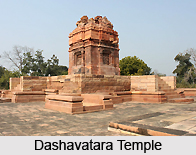 The Dashavatara Temple of Deogarh was built around the 6th century AD. Dashavatara Temple, made of stones, falls among the Gupta group of temples and is situated at Deogarh, Orissa. There is also a huge, open pillared hall, both of which are dedicated to one or the other of the ten incarnations of Vishnu. The temple stands on a wide platform with flights of steps on all the four sides, having a subsidiary shrine in each corner. The platform is decorated with sculptured panels depicting the scenes from the legends of Ram and Krishna.
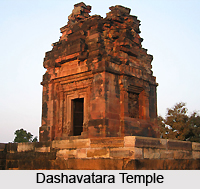 Architecture of Dashavatara Temple speaks a lot about the extensiveness and grandeur of the design. Dashavatara Temple was the first North Indian temple with tower or shikhara, even though the shikhara is unfinished and part of it has also disappeared (details as to when the shikara disappeared are not reported). The temple has high plinth and is set with cellar terrace. Dashavatara Temple has a "compelling presence" in spite of its decaying condition.
 Outside the platform, there are four stairways that provide access to the temple. However, as per details of excavation, combined with two small shrines with middle shrine seen now, the layout of the temple has been interpreted to represent a typical Panchayatana style of the temples of North India. The full height of the shrine is also based on isometric projections is about 45 feet (14 m). There are provisions of porches that has been corroborated but some equivalent comparisons with Varaha temple (boar incarnation of Vishnu) in the fort precincts, which belonged to the same period, suggests the existence of porticoes even in the Vishnu temple. Further, a later date with Kuriya Bira temple about 2 miles (3.2 km) to the south of the Vishnu Temple has been cited to substantiate that this temple had a Mandapa around a small Shikara shrine.