Archaeological excavations at Dangawada were carried out by the Directorate of Archaeology and Museum, M. P. Government and the Department of Ancient Indian History, Culture and Archaeology, Vikram University, Ujjain under the respective directions of M.D. Khare and V.S. Wakankar. The excavations were conducted in three sessions during the years 1978-79, 1979-80 and 1982-83. Artefacts belonging to ten cultural periods were discovered here starting from Kayatha culture to the Muslim period.
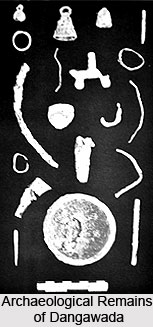 Artefacts of Kayatha Period
Artefacts representing Kayatha Period were discovered from the centre of Boreshwar mound. These were further categorised into two ages.
Artefacts of Ahar Chalcolithic Period
The representatives of this era are the stone and copper pestles, microliths and ceramic industry with lustrous red and painted black, red and grey ware. Designs include straight lines, simple bands, strokes, wavy lines and dots. Archaic bulls and terracotta bulls were also prevalently found.
Artefacts of Malwa Chalcolithic Period
Malwa Chalcolithic pottery were identified among the articles of this era which included stone objects, microliths, balls, pestles and hammer stones. The antiquities excavated from this era are the maximum. A shrine made of brick and plastered with mud has been found among the prominent structures. A sacrificial pit and a religious structural complex were also found during the findings. A terracotta mould for keeping copper axes, a copper chisel, storage jars along with charred grains, bone tools, balls of terracotta and stone and terracotta earlobe are also enlisted in the findings. There was a prevalence of painted designs in the pottery of this period.
Pre-Mauryan and Malwa Periods
Black and red wares were identified as the main artefacts of this period. Evidences of a drastic flood in this era have also been found but despite of that inhabitation was continuous. Use of iron has been first detected in this period. Terracotta beads, shell bangles and ear lobes have been discovered here. Punch-marked coins ring-wells and antiquities of iron and copper are also some of the distinguishing items of this era.
Artefacts of Sunga-Satavahana-Kshatrapa Periods
Remains of this period included a sacrificial pit, also known as yajna- kunda, terracotta seal with inscriptions in Brahmi script and an elliptical structure which may be the ruins of a temple. Large terracotta bulls, a small bowl of shell with a copper handle, silver coated bangles, ivory objects, a lead ear lobe, punch marked coins and semi precious stones were also found associated with these periods.
Artefacts of Gupta Period
Among the artefacts of Gupta period, terracotta figurines of animals and humans, beautifully adorned terracotta and shell bangles, terracotta beads, a terracotta mould of Yaksa and a chariot have been excavated. Structural remains of this era included a floor packed with pebbles.
Artefacts of Paramara Period
Early medieval pottery is quite prominent among the artefacts of Paramara Period. Course grey ware and reused bricks are found as the structural remains.
Artefacts of Post-Paramara Period
Archaeological researches have established that the destruction of this site was done by Muslim invaders during this era. The temples were demolished and the people migrated to the nearby mound which currently houses the inhabitants.