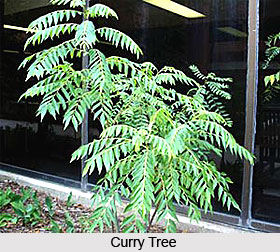
 The Curry Tree, also known as Karivepallai or Kadipatta is a tropical to sub-tropical tree in the family Rutaceae. Curry Tree is native to India and produces the leaves known as Curry leaves or Sweet Neem leaves. Curry leaves are cultivated in different parts of extreme north and south India. The Curry trees are also now maintained in homestead gardens, as in Kerala or in leaf farms as in Andhra Pradesh, Tamil Nadu, Karnataka and Orissa. The western world is fast importing actively to Indian curry leaf for relishing tangy foodstuffs that are not too hot.
The small and narrow leaves of Curry plant somewhat look like the leaves of the Neem tree; therefore they are also referred to as Karuveppilai (translated to Black Neem leaf) in Tamil and Malayalam, Karu or Kari meaning black, ilai meaning leaves and veppilai meaning Neem leaf. In the Kannada language, curry plant is known as Kari Bevu and Karivepaku in Telugu, again translating to the same meaning Black Neem leaf. Other names of Curry tree include Kari Patta (Hindi), which probably is a corrupt translation of Karuveppilai, noroxingha (Assamese), Bhursunga Patra (Oriya), Kadhi Patta (Marathi), Mithho Limdo (Gujarati) and Karapincha (Sinhalese).
Curry tree is a small tree, growing 4-6 m tall, with a trunk up to 40 cm diameter. The leaves are pinnate in shape, with 11-21 leaflets; each leaflet is 2-4 cm long and 1-2 cm broad. They are highly aromatic. The flowers are small white, and fragrant. The small black, shiny berries are edible, but their seeds are poisonous.
The leaves of Curry tree are highly valued as seasoning in South Indian and Sri Lankan cooking, much like bay leaves and especially in curries with fish or coconut milk. In their fresh form, they have a short shelf life though they may be stored in a freezer for quite some time; however, this can result in a loss of their flavour. They are also available in dried form, though the aroma is much inferior. The leaves of Murraya koenigii are also used as an herb in Ayurvedic medicine. The properties of Curry Plant include much value as an antidiabetic, antioxidant, anti-inflammatory, antimicrobial, hepatoprotective, anti-hypercholesterolemic and so on. Curry Plant is found in almost all parts of India nowadays and the leaves are extensively used in culinary items.