 Origin of Maheswari Sarees
The origin of Maheswari saree can be traced back to the 18th century. Then Indore District of Madhya Pradesh was under the reign of Queen Ahilyabai Holkar. It is said that once the Queen ordered the craftsmen to design a saree especially to gift the Royal guests and relatives. Then that nine yard saree became maheswari saree. It is believed that the design of the first saree of its kind was created by the Queen herself. These specially designed sarees were formerly worn by the ladies of Royal class. Today these sarees are available in both national and international market.
Design of Maheswari Sarees
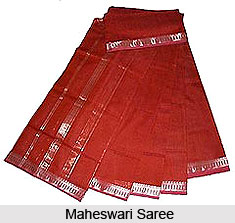
The Maheshwari Saree, mostly in cotton and silk, is characterised by its simplicity. The body is plain or has stripes or checks. The design and motifs of maheswari sarees are derived from the temples and palaces of Maheswar. The plain ones are known as chandrakala (midnight blue) and baingani chandrakala, which is woven with a blackish violet warp and a chocolate weft. Chandratara, the moon and star design, has lengthwise stripes of two shades and the pattern is arranged with four stripes of one shade attainted by one stripe of another shade. The reversible border of the saree which can be worn either side, is a specialty. The karnphool pattern is quite popular; it has a variety of leaves and flowers on the border. The pallu of Maheshwari saree is also distinctive with five stripes, three coloured and two white alternating. Now-a-days these sarees are made in natural and artificial silk as well. The chanderi cotton sarees are ideal summer wear. The sarees generally have a rich gold border and two gold bands on the pallu. The more expensive sarees have gold chicks with lotus roundels all over, known as butis. These Maheswari Sarees are extremely light weighted.
Technique of Maheswari Sarees
The artisans make the cotton thread by high reeling and weave cloth. The method of dying is practiced by making vegetable dyes from the locally available plants mainly of katha colour. The border of the sarees and motifs are woven with the colourful threads which are dyed by the local method. The clothes are quite durable and the motifs are quite peculiar.