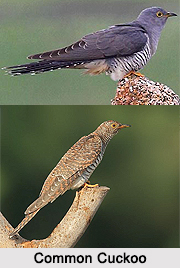
 Common Cuckoo is an Indian bird that bears as scientific name Cuculus canorus, known as a migrant of Europe to Asia in the winter months.
Category of Common Cuckoo
Common Cuckoo is a member of the cuckoo order of birds, Cuculiformes, which includes the roadrunners, the anis and the coucals.
Migration of Common Cuckoo
Common Cuckoo is a species which are widespread summer migrant to Europe and Asia, and winters in Africa. It is a brood parasite, which means it lays eggs in the nests of other bird species, particularly of dunnocks, meadow pipits, and Eurasian reed warblers.
Description of Common Cuckoo
Common Cuckoo gets its common name and genus name by onomatopoeia for the call of the male common cuckoo.
Structure of Common Cuckoo
Common Cuckoo is 32-34 centimetres long from bill to tail and a wingspan of 55-60 centimetres (22-24 in). The legs are short. It is greyish with a slender body and long tail and can be mistaken for a falcon in flight, where the wingbeats are regular. During the breeding season, common cuckoos often settle on an open perch with drooped wings and raised tail. There is a rufous colour morph, which occurs occasionally in adult females but more often in juveniles. The adult male Common cuckoos are slate-grey; the grey throat extends well down the bird`s breast with a sharp demarcation to the barred under parts. The iris, orbital ring, the base of the bill and feet are yellow. The grey adult Common cuckoo females have a pinkish-buff or buff background to the barring and neck sides, and sometimes small rufous spots on the median and greater coverts and the outer webs of the secondary feathers. Rufous Morph adult females have reddish-brown upperparts with dark grey or black bars. The black upper part bars are narrower than the rufous bars, as opposed to rufous juvenile birds, where the black bars are broader.
Plumage of Common Cuckoo
Common Cuckoos in their first autumn have variable plumage. Some are having strongly-barred chestnut-brown upperparts, while others are plain grey. Rufous-brown birds have heavily-barred upperparts with some feathers edged with creamy-white. All have whitish edges to the upper wing-coverts and primaries. The secondaries and greater coverts have chestnut bars or spots. In spring, birds hatched in the previous year may retain some barred secondaries and wing-coverts. The most obvious identification features of juvenile Common Cuckoos are the white nape patch and white feather fringes.
Call of Common Cuckoo
The male`s call, "goo-ko", is usually given from an open perch. During the breeding season the male typically gives this call with intervals of 1-1.5 seconds, in groups of 10-20 with a rest of a few seconds between groups. The female has a loud bubbling call. The song starts as a descending minor third early in the year in April, and the interval gets wider, through a major third to a fourth as the season progresses, and in June the cuckoo "forgets its tune" and may make other calls such as ascending intervals.
Concentration of Common Cuckoo
Common Cuckoo is essentially a bird of open land, the common cuckoo is a widespread summer migrant to Europe and Asia, and winters in Africa. Common Cuckoo arrives in Europe in April and leaves in September to the Asian countries like India, Pakistan, Thailand, Myanmar, Bangladesh, Vietnam and Cambodia. Common cuckoo has also occurred as a vagrant in countries including Barbados, the United States of America, Greenland, the Faroe Islands, Iceland, Indonesia, Palau, Seychelles, Taiwan and China.