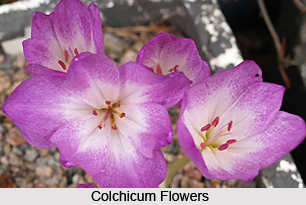
 The chief component of colchicum is the alkaloid, colchicine, which is present in the form of yellow chips, crystals or as whitish yellow amorphous powder. Its aroma is similar to hay when moistened and warmed.
Methods of usage
Colchicum comes to indispensable uses of common ailments like, it heals gout, rheumatism or open gashes, keeping in mind the precautionary measures.
Healing Power and Medicinal Properties of colchicum
It is a medicine of immense status in Afghanistan and northern India; the curative attributes were well known even amongst the Arabians. Its corms and seeds are integrated in the British Pharmacopoeia and allopathic medicine alludes it as an antidote for gout.
Gout cured by colchicum
The dynamic principle colchicine- incorporated in the corms, is useful in alleviating pain and swellings of gout. Scientific experiments with colchicum in minute dosages over a long period have testified successful in approximately 60% of patients. The seeds, primarily the rind also comprise colchicine, and can be used for treating gout in a similar manner resembling the corms.
Rheumatism cured by colchicum
The drug is advantageous in the treatment of rheumatic inflammation. A paste made with saffron and egg can be administered constructively to rheumatic and other inflammations.
Wounds healed by colchicum
Dried and pulverised root of the plant is useful in the remedying of wounds. It should be dusted on the affected area.
Precautions - Colchicum is extremely acrid to taste, and darkens in contact with light. It yields analogous action as colchicine, but the second is more active and lethal. When taken in large dosages, colchinine induces intestinal ache, diarrhoea and nausea. The use of the drug can cause grievous discomfort in the intestines. To counterbalance this, it is wise to have the drug together with belladonna or hyoscyamus (khurasana ajwain).