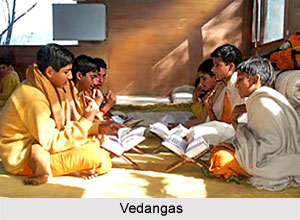
 Classification of Vedangas have six auxiliary disciplines closely associated with the study and understanding of the Vedas. These formed essential part of ancient Vedic education system.
(a) Siksha, (phonetics): Early grammarians maintained that distinct and accurate articulation of letters and sounds are required. Even Panini, the last of the Vedic grammarians (about 800 BC) emphasized on this fact.
(b) Kalpa (Ritual Practices): Geometry, Sanskrit, Sulva Sastra forms a major part of Kalpa. In medieval Sanskrit, it is known as rekba ganita, which means the lineal measurement of plane surface. The two words rekha (line) and lekha (writing) mean the same. The former applies to geometry and the latter applies to the depiction of feelings, ideas or thoughts, i.e. writing.
(c) Vyakarana (Grammar): Earlier the people of Central Asia spoke in a language known as Balhika Bhasha or Brahma Bhasha. On being requested by the Aryans, Indra, Chandra and Mahesa penned down the first scientific grammars. Then onwards Sanskrit, the more refined language came to be used. These grammarians then invented letters. The Brahmi Lipi known as the father of alphabets was perfected and established by Brahma, the first Aryan Pope. The Sarada, Sriharsha and Kutila are regarded as the grandfather of the later Indian alphabets. The Brahmi-Lipi was taken as the alphabet of the Aryans and Mahesa as their grammar. Panini has citied the alphabet of Mahesa.
Valmiki, Vyasa and his disciples has on the other hand tried to conserve the old Vedic School. Vedic Sanskrit existed till 1000 BC and from 1000 BC to 700 BC sacred Sanskrit and secular Sanskrit equally prospered. From 700 BC, Pali remained the supreme for the next five hundred years. Later from 800 BC Panini flourished and assembled his works on Grammar in Eight Lectures.
(d) Nirukta: (etymology): Nirukta is the science of etymologies. It deals with the interpretations and explanations of obscure words in Vedas.
(e) Chandas: Chandas is the knowledge of metres which deals with the analysis of various metres employed for the construction of different Vedic hymns.
(f) Jyotisha: It deals with the knowledge of astronomy. It deals with the astronomical and astrological aspects.