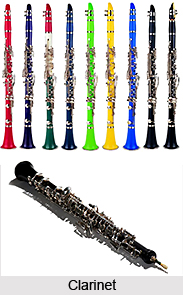
 The Clarinet is a musical instrument that belongs to the woodwind family. The instrument has an approximately cylindrical bore and uses a single reed. The clarinet family is the largest woodwind family and comprises a wide range of instruments of differing sizes and pitches. Of these many are rare or obsolete, and music written for them is usually played on one of the more common types. The unmodified word clarinet usually refers to the B flat soprano clarinet, by far the most common clarinet. The clarinet is one of the youngest woodwind instruments.
History of Clarinet
The term "clarinet" appears for the first time in the archives of the city of Nuremberg in 1710. It was invented in Germany by Johann Christoph Denner sometime around the turn of the 18th century, by adding a register key to the earlier chalumeau. The wind instrument was improved several times during the course of the 18th century. Over time additional keywork and airtight pads were added to improve tone and playability. Today, the clarinet is used in both jazz and classical ensembles, as well as in chamber groups and as a solo instrument. In Indian music, the clarinet is used in the field of Carnatic music. The clarinet was brought to India during the reign of King Sarabhoji II of Tanjavur. It is believed that it was Mahadeva Nattuvanar who first used the clarinet for performing Carnatic music. Even during Sarabhoji"s reign it was being used as an accompaniment for the Chinna Melam (the lesser ensemble) which accompanied the dance performances of the Devadasis.
Construction of Clarinet
The modern clarinet shape dates from around 1700, but nowadays, the instrument has eighteen tone-holes and 20-22 keys. The clarinet has a single reed and a cylindrical bore. The reed is made from the cane of Arundo Donax, which is a type of grass. It can also be manufactured from synthetic materials. The body of the clarinet is made from a variety of materials including wood, plastic, hard rubber, metal, resin, and ivory. The vast majority of clarinets used by professional musicians are made from African hardwood, mpingo (African Blackwood) or grenadilla.
Most modern inexpensive instruments are made of plastic resin. Mouthpieces are generally made of hard rubber, although some inexpensive mouthpieces may be made of plastic. Other materials such as crystal, glass, wood, ivory, and metal have also been used. Other ligature materials include wire, wire mesh, plastic, Naugahyde, string, or leather. The ligature fastens the reed to the mouthpiece. When air is blown through the opening between the reed and the mouthpiece facing, the reed vibrates and produces the instrument`s sound. The clarinet sounds almost "dark" in its low register, exceedingly mild in its middle register, and very penetrating and even raucous in its upper register, which was only exploited for the first time in jazz. The clarinet can be tuned to any key, but nowadays the B-flat clarinet is the most popular.
Uses of Clarinet in Indian Music
Being a versatile instrument, the Clarinet has been used by many musical traditions around the world. In India, the clarinet is used in Carnatic Music performances. It found a place in Carnatic music orchestras that began doing the rounds in the late 19th and early 20th century. Pandit Narasimhalu Vadavati is the first clarinettist who has successfully adapted the clarinet, a western instrument, to Hindustani classical music. He has had a long and distinguished career. Immense contribution was made by AKC Natarajan in the acceptance and adaptability of the clarinet to Carnatic music. He has perfected a technique of performance which has made the instrument most suitable for Carnatic music.