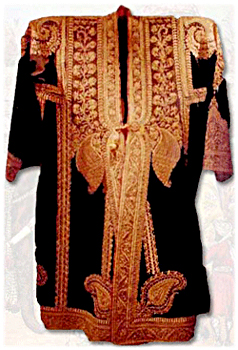
 The choga is a popular garment amongst the Rajasthani men. It is described as a long-sleeved robe that fits freely around the bodice and does not have a noticeably tailored look. Conventionally, the choga has a deep oval or heart-shaped neckline. A pair of loops and cloth-cased buttons fastens the garment at the chest. It is worn as an outer-garment over a kurta or angarkha and is generally made of fine woven wool, though fine cotton is also used. Often, it was made of brocaded material or velvet embroidered with metal embroidery.
The word choga is from Turkish origin. The choga was worn as an outer garment in Central Asia. Ancient literature, Buddhist sculptures from Satavahana period and Gupta paintings signify that the origin of the choga predates the Christian era. By the medieval period, this coat-like garment had a very definite presence in India and was the preferred garment of the nobility.
In the Rajasthani context, the choga was a much more splendid and formal garment than one would gather from its usual description. Numerous museum-exhibits, portraits and paintings of royalty show that the choga was made of ornate fashion like brocade and embellished with lavish embroidery. The intricate detailing in its design, as with the loop, tells the story of the elite`s extensive use of the choga. Thus, the choga was an elegant, comfortable overcoat that enjoyed royal patronage.
The choga made of muslin or woven in the jamdani (flowered muslin) style was worn in summer. It was lightly embroidered with silks, befitting the season. It usually had a narrow floral border on the edges and large floral sprays on its front, back and shoulder and on the lower edges. In winter, woollen and quilted choga were preferred, which were embroidered with silk and zardozi. Often, the embroidery was detailed and the choga was stitched with utmost care, sometimes, with a double-lining of cotton and silk. Though rarely worn now, the garment choga has reappeared, of late, in a more urban form and is occasionally incorporated in the collections of some contemporary designers.
This article is a stub. You can enrich by adding more information to it. Send your Write Up to content@indianetzone.com