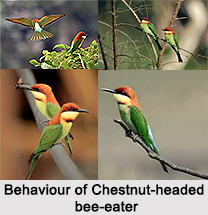
 Chestnut-Headed Bee-Eater is an Indian Bird that bears a scientific name "Merops leschenaultia", concentrated in the Indian states and the Asian countries.
Concentration of Chestnut-Headed Bee-Eater
Chestnut-Headed Bee-Eater is a passerine bird in the bee-eater family Meropidae. It is a resident breeder in the Indian subcontinent and adjoining regions, ranging from India east to Southeast Asia, including Thailand, Malaysia and Indonesia.
Structure of Chestnut-Headed Bee-Eater
Chestnut-Headed Bee-Eater like other bee-eaters is the richly coloured and the slender looking bird. Chestnut-Headed Bee-Eater is predominantly green, with blue on the rump and lower belly. Its face and throat are yellow with a black eye stripe, and the crown and nape are rich chestnut. Chestnut-Headed Bee-Eater is a thin curved bill which is black in colour. The sexes of Chestnut-Headed Bee-Eater are alike, but young birds are duller. This species is 18-20 cm long; it lacks the two elongated central tail feathers possessed by most of its relatives.
Size of Chestnut-Headed Bee-Eater
The forehead, crown, nape, lower face and ear-coverts are bright chestnut ; lores black, continued as a band under the eye and ear-coverts ; wing-coverts, lower back and tertiaries green, the latter tipped with bluish; rump and upper tail-coverts pale shining blue; primaries and secondaries green, rufous on the inner webs, and all tipped dusky ; central tail-feathers bluish on the outer, and green on the inner webs ; the others green, margined on the inner web with brown and all tipped dusky ; sides of face, chin and throat yellow ; below this a broad band of chestnut extending to the sides of the neck and meeting the chestnut of the upper plumage ; below this again a short distinct band of black and then an ill-defined band of yellow ; remainder of lower plumage green, tipped with blue, especially on the vent and under tail-coverts.
Breeding Season of Chestnut-Headed Bee-Eater
Chestnut-Headed Bee-Eater is a bird which breeds in sub-tropical open woodland, often near water. It is most common in highland areas. As the name suggests, bee-eaters predominantly eat insects, especially bees, wasps and hornets, which are caught in the air by sorties from an open perch.
Nestling of Chestnut-Headed Bee-Eater
Chestnut-Headed Bee-Eaters are gregarious, nesting colonially in sandy banks. They make a relatively long tunnel in which the 5 to 6 spherical white eggs are laid. Both the male and the female take care of the eggs. These birds also feed and roost communally.
Sounds of Chestnut-Headed Bee-Eater
The call of Chestnut-Headed Bee-Eater is similar to that of the European bee-eater.