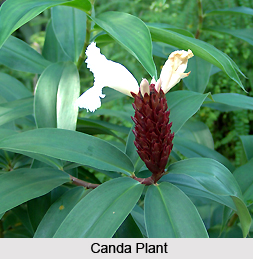
 The Indian medicinal plant named Canda or Keokanda has a botanical name of Costus speciosus (Koenig) Sm and it is known in several names in different Indian languages. Canda is the Sanskrit name of the plant and it is also called as Kushta in Sanskrit. Apart from Keokanda, the other Hindi names of the plant are Keu and Kust. The Bengali people known the plant as Keu and Kust and in Gujarati, it is known as Pokaramula. The Marathi names of the plant are Kemuka, Penva, Pinnga and Pushkarmula and the Tamil speaking people named it as Kottam, Kuravamkuttaiyidukki, Kugaiman-Jal, Malaivasambu, Ubariyavi and Vengottam. The Telugu speaking people know the plant as Bommakachika, Chengalvakoshtu, Kushthamu and Pushkaramulam.
Canda or Keokanda is an erect succulent herb having a height of up to 2.7 m and the plant has a tuberous rootstock. The leaves of the plant are spirally arranged on stem and they have a length of 15-30 cm and width of 5.7-7.5 cm. The leaves are oblong to oblanceolate and they are glabrous above, with silky pubescent beneath. The apex is caudate-acuminate, and the base is rounded. The large flowers of the plant are of white colour with a yellow centre and they are usually borne in dense terminal spikes. The length of the ovate bracts is 2-3.2 cm and the colour is bright red to reddish-brown. The fruit or capsule of the plant is ovoid, with a diameter of 2 cm and the 3-valved fruit becomes red when ripe. The black seeds of the plant have a white aril.
Canda is mainly found in moist tropical and subtropical regions of India up to about 1000 m elevation. The plant and is particularly common in West Bengal, Konkan (coastal districts of Maharashtra) and South India and they are often cultivated as an ornamental plant, as well. The plant has some greatly useful medicinal properties and usages. The root of the plant is considered bitter, astringent, purgative, depurative, stimulant, tonic and anthelmintic. In the Ayurvedic medicine, the plant is used for treating diseases like bronchitis, fever, dyspepsia, inflammations, anaemia, diabetes, leprosy and other skin diseases, rheumatism and lumbago. The plant`s root is considered as an ingredient of many compound Ayurvedic drugs.
In northern India, the root of Canda or Keokanda plant is used as a substitute for the roots of Gloriosa superba (Colchicaceae). It is reported to be used to treat fevers, eye, skin and urinary diseases, and mental disorders, in Siddha and it is also an ingredient of the drug named Amber mezhugu that is mainly used for treating rheumatism. The juice of the stem bark of this plant is reportedly taken for getting relief from burning sensations in urination. The Kadars of the Anamalai Hills of Tamil Nadu use the filtrate of the root paste as an eardrop to promote the healing of ear infections. Apart from that, they also eat chutney made from the burnt tuber of the plant, sugar and tamarind for the treatment of dysentery and other digestive problems.