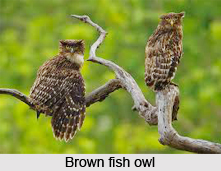
 Brown Fish Owl is an Indian bird that bears a scientific name "Bubo zeylonensis" or "Ketupa zeylonensis" occupies a range of over 7000 kilometres from China to Palestine.
Category of Brown Fish Owl
Brown Fish Owl is a species of owl that is part of the family known as typical owls, Strigidae, which contains most living owls.
Habitation of Brown Fish Owl
Brown Fish Owl inhabits the warm subtropical and humid tropical parts of continental Asia and some offshore islands. Of the four living species of fish owl, it is the most widely distributed, most common and best-studied. It occupies a range of over 7,000 km from eastern China to Palestine.
Concentration of Brown Fish Owl
Brown Fish Owl is an all-year resident throughout most tropical and subtropical parts of the Indian Subcontinent to Southeast Asia and adjoining regions. The west of its main range, it is patchily distributed to the Levant and southern Asia Minor.
Nests of Brown Fish Owl
The typical habitat of Brown Fish Owls is forest and woodland bordering streams, lakes or rice fields. It inhabits mainly the lowlands, from open woodland to dense forest as well as in plantations; in the Himalayas foothills it ranges into sub montane forest up to 1,500 m (4,900 ft). It frequently spends the day in stands of bamboo or other large shady trees. They can be found around water reservoirs of Indian states, along canals, on the outskirts of villages and along sea coasts. Western birds are found in semiarid landscape and may breed in oases in arid regions. Regardless of habitat, it rarely strays far from larger bodies of water such as rivers and lakes.
 Structure of Brown Fish Owl
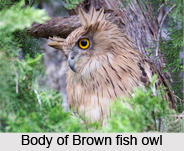
Brown Fish Owl is a large owl, but it is intermediate in size between other fish owls. It ranges from 48 to 58 cm (19 to 23 in) in length and in wingspan from 125 to 140 cm (49 to 55 in). Weight can vary considerably, reportedly ranging from 1.1 to 2.5 kg (2.4 to 5.5 lb). Some of the variability is attributed to the range of sizes across the subspecies. Also, females are invariably at least somewhat larger than males and condition of birds is variable. It has prominent ear tufts but as in all fish owls, their tufts hang to the side of the head and have a scraggly look. The upperparts are rufous brown and heavily streaked with black or dark brown. The under parts are buffy-fulvous to whitish with wavy dark brown streaks and finer brown barring. The throat is white and can be conspicuously puffed, while the facial disk is indistinct. The irides are golden yellow, the feet a duller yellow, and the bill is dark. Sexes do not differ in appearance except for size. Second-year fish owls of this species tend to be somewhat paler than full adults.
Similarity with Owl Family
It is compared to eagle owls of similar length, Brown fish owl tend to be even shorter in tail length and even heavier in build, have relatively larger wings (the tawny and Blakiston`s being particularly chunky in shape), have considerably longer legs, and have a rough texture to the bottom of their toes. At least the latter two features are clear adaptations to aid these owls in capturing fish. Diurnal raptors who feed largely on fish have similar, if not identical, rough texture under their toes, which helps these birds grasp slippery fish. Unlike diurnal raptors who capture fish such as the osprey as compared to most terrestrial raptors, the fish owls have large, powerful, and curved talons and a longitudinal sharp keel sitting under the middle claw with all having sharp cutting edges that are very much like those of eagle owls. Also, unlike fish-eating diurnal raptors will not submerge any part of their body while hunting, preferring only to put their feet into the water, although fish owls will hunt on foot, wading into the shallows. Unlike most owls, the feathers of fish owls are not soft to the touch and they lack the comb and hair-like fringes to the primaries, which allow other owls to fly silently in order to ambush their prey. Due to the lack of these feather-specializations, fish owl wing beats make sounds.
 Flight of Brown Fish Owl
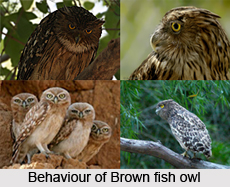
Brown Fish Owl in particular is said to have a noisy wing beat, sometimes described as producing a singing sound, but another description claimed they could be "as silent as any other owl" in flight. The lack of a deep facial disc in fish owls is another indication of the unimportance of sound relative to vision in these owls, as facial disc depth (as well as inner ear size) is directly related to how important sound is to an owl`s hunting behaviour. Also different from most of other kinds of owls, the bill is placed on the face between the eyes rather below it, which is said to impart this fish owl with a remarkably morose and sinister expression.
Sounds of Brown Fish Owl
Brown Fish Owl calls are described as a deep, trisyllabic tu-hoo-hoo, which is seemingly the territorial song emitted before breeding. The call of brown fish owl has been described as comparable to that of a distant Eurasian bittern. Other calls recorded for the brown fish owl have included a soft, "almost human-like" huphuphuphuphuphup or a loud huhuhuhuhuhuhu. Another call is a boom-uh-boom.