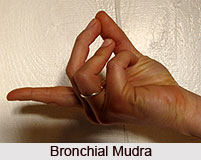
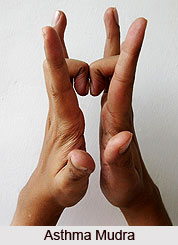
 Bronchial and Asthma mudras are very good for respiratory problems and are executed with both hands. This Bronchial and the Asthma Mudras can be done for a few minutes one after the other until the breathing calms down. For prolonged treatment these two Mudras can be done five times every day for five minutes.
Asthma mudra is done with both hands. The way of practicing Asthma mudra involves pressing fingernails of the middle fingers while the other fingers are extended. This is effective for asthma attacks.
 Bronchial mudra is practiced by placing the little finger at the base of the thumb; the ring finger is placed on the upper thumb joint and the middle finger or the top soft portion of the thumb. The index finger should be extended. Bronchial mudra is done along with the Asthma Mudra.
These mudras involve inhalation and exhalation. While performing this, consciousness is needed to stick into abdomen, stomach, chest, throat, forehead, and top of the head. The breath is needed to be held for about five seconds.
Bronchial mudra is practiced by placing the little finger at the base of the thumb; the ring finger is placed on the upper thumb joint and the middle finger or the top soft portion of the thumb. The index finger should be extended. Bronchial mudra is done along with the Asthma Mudra.
These mudras involve inhalation and exhalation. While performing this, consciousness is needed to stick into abdomen, stomach, chest, throat, forehead, and top of the head. The breath is needed to be held for about five seconds.
During exhalation, consciousness should be directed from top to bottom and backward count should be done from 7 to 1. The practitioner should wait patiently until the impulse to inhale comes, and then the consciousness is again directed back to the top, while inhaling. The pauses after inhaling and exhaling are very important here.
Harmonising to the Bihar School of Yoga, mudras work magic on the human nervous system because they are linked to closely to human biological persona or map in the human brain. In medical language this is called the homonculous man. Mudras manipulate it to reach the autonomous nervous system which controls breath rate and heart rate that will otherwise be not be under the control of the mortal.