
The twenty-seventh yogic sutra speaks in detail of the seven worlds - seven above and seven below. They correspond with various parts of the human body and are strictly interlinked. A yogi, who has gains all knowledge of the soul, is able to perceive both the functions of the worlds. According to the yogis, the seven primary cakras are placed in the aerial region - the world above. And a yogi shines in the light of both the internal and external realisation.
Bhuvanajnanam knowledge of the worlds
Surye on the sun
Samyamat by constraint, by integration
By sarhyama on the sun the yogi will have knowledge of the seven worlds, and of the seven cosmic centres in the body.
As the sun illuminates the world with its rays, likewise, the light of the soul reaches the sahasrara, the thousand-petalled cakra, also known as brahmakapala. The yogi knows the functions of both the outer and the inner worlds.
According to Indian philosophy, there are fourteen worlds or divisions of the universe - seven above and seven below. Those above are called the aerial region. They comprise the bhuloka, bhuvarloka, suvarloka, mahaloka, janoloka, tapoloka and satyaloka. Those below are the nether regions. They comprise the atala, vitala, sutala, rasatala, talatala, mahatala and patala. All these worlds are interdependent and interconnected.
As the microcosm symbolises the macrocosm, man`s body epitomises the entire structure of the great universe. The fourteen worlds are represented in the various regions of the body from the crown of the head to the soles of the feet. Considering the bottom portion of the torso as the central point, the aerial regions are situated above, and the nether regions below it. The several aerial regions correspond as follows - pelvic region to bhuloka, navel to bhuvarloka, diaphragmatic to suvarloka, heart to mahaloka, neck to janoloka, eyebrow centre to tapoloka and crown of the head to saty aloka. The seven nether worlds are delineated as follows - hips to atala, thighs to vitala, knees to sutala, calves to rasatala, ankles to talatala, metatarsals to mahatala and soles of the feet to patala.
According to yogis, the seven major cakras are placed within the aerial regions. They are muladhara (seat of the anus), svadhistana (sacral area), manipuraka (navel), anahata (heart), visuddhi (throat), ajna (eyebrow centre) and sahasrara (crown of the head). There are other cakras, like surya (corresponding to the sympathetic nervous system), candra (parasympathetic nervous system) and manas (seat of the mind). All these are interlinked, like the solar system. The light that shines from the seat of the soul is the sun of life. It passes through surya nadi at the gates of surya cakra and lights the seven states of awareness in the yogi`s consciousness (11.27).
Patanjali speaks not only of external, but also about internal achievements. He instructs the aspirer to channelise his mind towards the inner body, to study and earn knowledge of the soul.
Bhuvanajnanam surye samyamat
This is the twenty-seventh yogic sutra, which is incorporated within the third phase of the Patanjali Yoga Sutras.
Recently updated articles in Yoga
Khanda Manda Yoga
Khanda Manda Yoga is a difficult form of yoga where the Yogi cuts off his own arms and legs with a sharp cleaver, that is axe-like knife, and throws t...
Kaivalya Pada
Kaivalya Pada, the fourth chapter of Patanjali Yoga Sutra denotes an absolute, indivisible state of existence of the Yogi. The Kaivalya Pada is someti...
Vibhuti Pada
Vibhuti is the Sanskrit term for “power” or “manifestation.” In this third chapter, Patanjali introduces the final three limbs of Aṣṭanga Yoga, collec...
Sadhana Pada
Sadhana Pada in Patanjali Yoga Sutra denotes the idea of practicing yoga that leads to spiritual illumination. Sadhana, the Sanskrit term for “practic...
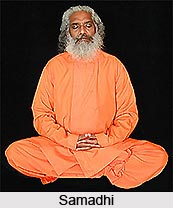
Samadhi Pada
Samadhi Pada is the first chapter of Patanjali Yoga Sutra. In this chapter, the author explains the essence of yoga, the nature of samadhi, and the me...
Related articles in Yoga
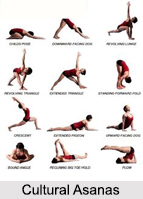
Cultural Asanas
Cultural Asanas refer to the daily physical exercise postures that train the body and mind in Yoga Practice.
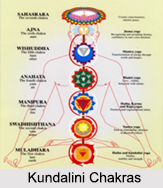
Kundalini Chakras
Kundalini Chakras are psychic energy centres or vortices, which connect between our psychic and physical energy systems.
Patanjali Yoga Sutras
Patanjali’s Yoga Sutras presents a foundational guide to the philosophy and practice of yoga. Through concise aphorisms, it outlines the nature of the...
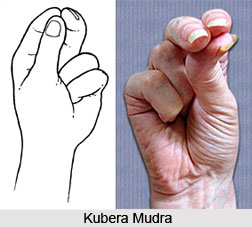
Kubera Mudra
Kubera Mudra, a form of Hatha Yoga, leads to the elevation of mental peace and physical relief by proper practice and cleanses frontal sinuses.