 bhava arising or produced from, originating in, state of being,
existence, origin, true condition, real disposition
bhava arising or produced from, originating in, state of being,
existence, origin, true condition, real disposition
pratyayah going towards, firm conviction, usage, means, device
videha incorporeal, without material existence but an existence in contemplation of a law (the law of nature and of the spirit)
prakrtilayanam merged in nature
In this state, one may experience bodilessness, or become unified with nature. This may lead to isolation or to a state of loneliness.
In this samadhi, which is balanced between labija and nirbija samadhi, the sadhaka is liberated from all fluctuations, but subliminal impressions, samskaras, bounce to life the moment he comes out of that state. Some evolved entities move without a body, like spirits and angels, whereas others become absorbed in the elements of nature, prakrti. Caught in the mesh of bodiless feeling, or unifying in nature, they forget to climb to the topmost rung of the spiritual ladder, and fail to reach nirbija samadhi. The sadhaka, having reached a state of isolation but not emancipation, must come out of it if he does not wish to lose the path of kaivalya.
A man who performs trance underground without ventilation becomes one with the earth. A person submerged in water becomes one with water. He is a prakrtilayan - one with the elements. One whose spirit moves without a body is a videhin. When the prakrtilayan is distinguished from earth or water, or the videhin comes in contact with his own body, subliminal impressions show up and produce fluctuations in the mind. This experience is the conquering of the principles or tattvas of nature - prakrtijaya.
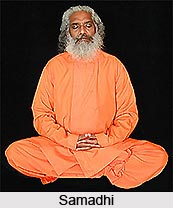
In 1.10, Patanjali defines sleep as a state in which all thoughts and feelings are temporarily suspended, and the senses, mind, intellect and consciousness rest in the being. In dreamless sleep, there is absence of everything. If an average person, when awake, recalls the state of dreamless sleep, he glimpses a non-physical state of existence {videha) and also the state of unifying with nature (prakrtilaya). In sleep, these two phases remain unconscious until one wakes, while evolved souls in samadhi (as described in 1.18) experience them consciously. Sleep is a natural condition of consciousness; samadhi is a super-conscious state.
In sleep, everything is inert, tamasic; in samadhi everything is luminous, untainted by the gunas.