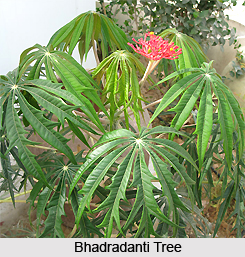
 Bhadradanti is a large shrub or small tree that reaches a height of up to 3 m. The botanical name of the plant is Jatropha multifida L. and it is called as Coral plant or small physic nut in English. There are many names of the plant in different Indian languages. Apart from Bhadradanti, the plant is also known as Guchhphala and Vishab-Hadra in Sanskrit. The Kannada names of the plant are Havalada Mara, Simeauvdala and Vilayatiharalu and in Marathi; it is known as Chiniyerandi. The Tamil speaking people know the plant as Kattunervalam and Malaiya-Manakku. The plant is widely cultivated in the gardens of India for having ornamental foliage. It is occasionally naturalised in India. However, it is not a native to India and its origin is in the tropical South America.
The leaves of Bhadradanti are orbicular and have long petioles. The leaves are 7.5-12.5 cm wide and are palmately divided into 5-11 lobes, which are lanceolate-acute or elliptic-acute. The coral red flowers of the plant are borne on many-flowered, long-pedunculate and flat-topped terminal cymes. The plant`s fruit (capsule) has 3 lobes and is about 2.5 cm long. The obovate fruit is smooth and become yellowish in colour, when ripe.
Bhadradanti has many useful medicinal properties and uses. The plant is used frequently in the traditional Indian medicines. Ayurveda consider the fruit of Bhadradanti as pungent, heating and purgative. The fruit is sometimes used as an external application for treating enlarged spleen, piles, wounds and skin diseases. A decoction of the dried roots of this plant is also used to relieve indigestion and colic and it is sometimes used as a tonic as well. The leaves of Bhadradanti are also used to treat scabies and as a purgative. Sometimes, the latex of the plant is applied to promote healing of wounds and ulcers as well.
However, one should be careful while using different parts of Bhadradanti for treatment. Though the fruit and seeds of the plant are often used for medicinal purposes in India, both are considered poisonous, particularly to children. The fruit and seeds can cause vomiting and intense burning pain in the stomach. If somebody ingests them, he/she is advised to take lime juice and stimulants as antidotes.