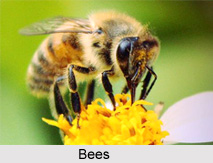
 Bees evolved in unison with the flowering plants. Bees are thought to have split off from the sphecoid wasps and have turned to a strict nectar-and-pollen diet from their predominantly carnivorous ancestors. Bees are sometimes difficult to distinguish from wasps, flies and other insects which mimic them, but the presence of branched hairs on the body and the basal larsal segment of the hind leg being wider than the succeeding segments, plus the purely flower-feeding diet, enable their identity to be maintained. The honey bee is apparently universally known to man through its produce, honey. Apart from the three species of social bees that store honey in their combs 20,000 species of bees have been classified into some 250 genera and have been arranged in nine families.
The external features of bees are multifold: some bees may be without any hairs and slender, resembling wasps. Many of them are fuzzy and rotund with a loud buzzing noise while in flight. Most bees are strikingly coloured, adorned with stripes, spots or patches of red, green, blue, yellow, black, white, orange or brown. In size they may vary from 15 mm to over 50 mm in length, and most female bees possess a sting, while all males lack this organ.
Bee species are solitary and each female constructs her nest without cooperation and attends to the functions of worker. Bee nests are very variable in location and form; they may be made in soil, in wood or in pith of stems where a burrow is tunneled; or it may be a nest made of resin, clay, mud etc or on branches of trees or other protected or exposed situations. The nests and cells are made of wax secreted from bee bodies or collected from plants, silk produced by the adult bee, dung, mud, resin, pebbles, sand, cut portions of leaves or petals, saliva, plant hair or fibre or secretions from the Dufour`s Gland located in the sting. The nests may be positioned or built on trees, rocks, walls, or in existing cavities anywhere, in trees, rocks, holes made by other insects, or in man-made things like gun barrels, keyholes and the like. Nests are constructed solely by females; no males usually help in nest-building, defense or in provisioning with food.
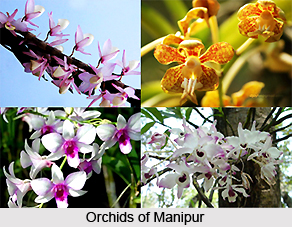
 Bees take their food from flowers, the nectar being their chief source of carbohydrates, and the pollen giving them the proteins they need. Some bees are very specific in the flowers that they visit, depending on only a single species of flowering plant or maybe a genus. These are called monolecttc bees. Some others may gather pollen and nectar from a series of related genera and some more visit flowers of many unrelated plants. Though most bees fly by day (diurnal), some venture out to flowers only at night (nocturnal) because the flowers that they depend on open only at night. Bees also carry pollen in tufts of hair located either on the hind leg or on the underside of their abdomen.
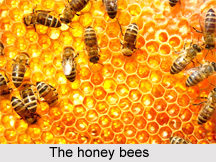
Bees contain some species that exhibit a highly advanced form of social behaviour. The different types of social behaviour can be categorized as follows: parasocial bees that form small groups of female adult bees of the same generation that usually share a nest; in these are also included communal bees where each female constructs her own cells, provisions them and oviposits in them. The quasisocial bees (all female bees lay their own eggs but share the task of cell construction and provisioning) and semi-social bees (which have a division of labour-some females laying eggs and others constructing cells and provisioning) are slightly advanced in their social behaviour. Then, the subsocial bees have a family group that comprises an adult that feeds her larvae by progressive provisioning. The eusocial bee female constructs her own nest and performs all other duties by herself initially; later, when her daughters mature, they remain in their nest and perform the duties of workers while the foundress female becomes the egg-laying queen bee. Lastly, the highest form of social behaviour is exhibited by the hypersocial bees or the honey bees where there is a very specialized social arrangement and among them the queen bee is specialized for egg-laying and cannot, by herself, begin a new nest without the help of her swarm of worker bees.
The honey bees or Apis are by far the dominant and well known bees in India. The main honey bee in the Indian subcontinent is Acerana which replaces the temperate honey bee A. mellifera. These honey bees are the most highly specialized members of the Apoidea with a complex social organization.
Lastly it can be said that bees are the major group of insects that are intimately associated with the pollination of crop and wild plants and have evolved in conjunction with several species of flowering plants.