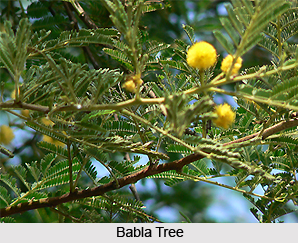
 Babla or Babula is a small to medium-sized, almost evergreen tree with a short trunk. It has a spreading crown and feathery foliage. Leaves are bipinnate, flowers are golden-yellow in colour, fragrant, and are crowded in long-stalked globose heads. Fruits of this plant are stalked, constricted between the circular seeds that are densely and persistently grey downy. Flowering occurs generally during the rainy season, occasionally to December; fruiting usually from April to June. The botanical name of this plant is Acacia nilotica. Three varieties of Babla plant are recognized in India: (1) Cupressiformis Stewart characterized by its broom-like ascending branches; (2) Vediana Cooke, a smaller variety with rough, fissured bark; and (3) Indica, the most common variety found in natural and plantation forests.
Babla or Babula is also known as Indian gum arabic tree in English, babul in Bengali, Urdu, Hindi, Marathi, Konkani and bamura in Gujarati. Though this plant is apparently native to Egypt, the Arabian Peninsula and India, Babla is cultivated and naturalized in many tropical and subtropical countries. It is a very common species in dry to moist inland habitats nearly throughout India from Punjab to West Bengal southwards, where it often forms pure stands or is dominant in mixed stands. It is usually confined to low elevation sites on flat or gently undulating terrain and ravines, though is occasionally found on sites up to 900 metre elevation. Its common associates include Acacia leucophloea, Prosopis cineraria, Azadirachta indica, Ziziphus jujuba and Cassia auriculata.
Babul or Babla is known for its medicinal usages. In Ayurveda the bark is considered astringent to the bowels, alexiphaxmic and anthelmintic; it is used to treat coughs, bronchitis, diarrhoea, dysentery, biliousness, piles, leucoderma and urinary discharges, A decoction of the bark is used as a gargle to relieve sore throat and toothache. The leaves are considered useful for treating bronchitis, piles, eye diseases and to promote healing of bone fractures. In Unani medicine they are used as a liver and brain tonic, antipyretic, and for treating leucoderma, gonorrhoea, strangury and ophthalmia. The gum exuded from the cut bark (babul gum) is used as a substitute for true gum arabic as an astringent and styptic. It is used in Ayurvedic practice to treat biliousness, leprosy, urinary, vaginal and uterine discharges, and in Unani medicine as an antipyretic, liver tonic and for treating sore throat, cough, piles, burns and colic. Among the Irulars of Tamil Nadu the powdered gum is mixed with egg-white and applied externally to relieve scalds and burns. A decoction of the pods is used in the treatment of urinogenital diseases. An infusion or the pulp of the tender leaves mixed with rice water is used as an astringent and remedy for diarrhoea and dysentery. The twigs are used as toothbrushes in some locales. The tannin-rich bark is highly valued for tanning, particularly in northern India. A decoction of the bark is used as a substitute for soap, and the unripe pods are sometimes used to make ink.