 Ayyappan Thiyyattu is generally performed in central districts of Kerala that is performed by the minuscule ambalavasi community who lives in districts of Thrissur, Palakkad and Malappuram. This is a male art that centres on the mythological story of the birth of Lord Ayyappa from the relationship of Lord Vishnu in his transient impersonation as Mohini and Lord Shiva.
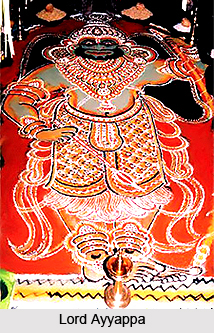
his involves four phases of presentation: a) Kalamezhuthu (sketching the kalam of Ayyappa using natural colours), b) Kottum Pattum (rendition of invocation songs of Ayyappa and a narration of the story of his birth), c) Koothu (a gesture-laden dance enacting the build-up story to the delivery of the lord) and d) Velichchappaadu (a frenzied dance that eventually erases the kalam where the image of the lord is sketched on the sanctified floor).
Lord Ayyappa`s picture is sketched and embellished in white, yellow, green, red and black natural colours. It is shown that the lord holds his weapons like the sword and the bow-and-arrow. In some versions it is shown that Lord Ayyappa is mounted on the tiger or the horse.
The songs are accompanied by the beats of `para` and the cymbals called ilathalam. Lord is praised in Malayalam and Tamil languages with a streak of endemic classical tunes. Koothu is enacted with definite costumes but no make up. There are hardly any facial emotions, dance movements are least and hand gestures looks like lesser but refined versions of Koodiyattam and Kathakali. It is accompanied by chenda, ilathalam and `para`.
The Velichchappadu or vision wields a small sword. He is bare-chested and has a flowy hair; the face is either bearded or clean-shaved. Initially the steps are slow however eventually it gains tempo. Thereafter Velichchappadu leaps on to the image in a rage. Later on he is calm when the image is erased with both legs. Lord`s face is erased alone with the right hand.
At times Ayyappan Thiyyattu is staged in bigger forms that last from dawn to late night when it is called Udayasthamaya Thiyyattu. In that case the Koothu would deal with twelve stories ahead of the birth of Lord Ayyappa. Thiyyadi Nambiar families enjoy the popularity of their art more in the upstate Malabar belt.