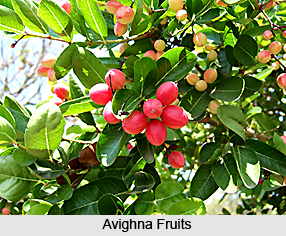
 Avighna plant is botanically known as Carissa carandas L. Avighna plant is native to India and found in dry forests throughout the country. It is also frequently cultivated in gardens for its edible fruits. All parts of the Avighna plant are used in conventional Indian medicine. This Indian medicinal plant is an It is an evergreen shrub or small, crooked tree. In Bengali it is known as Bainchi, Karamcha, Karancha; in Gujarati it is Karamadi, Karamda, Timbarran; Hindi: Garinda, Karaunda, Kantakregi, Karondi, Korada; Kannada: Heggarichige, Karekayi, Kavali; Konkani: Carandam; Malayalam: Karakka, Karavanda; Marathi: Karvanda; Oriya: Kerendo Kuli; Sanskrit: Avighna, Kanachuka, Karamarda, Karamar-Daka; Tamil: Kalaka, Kalakkay, Karaikkay, Kila, Perungkala; Telegu: Kalivi, Ped-Dakalavi, Vaka, Vakkaaya; Urdu: Karwanah and in English Avighna is recognised as English: Christ`s thorn, Karaunda;
Avighna plant rises upto a height of 3 metres with dichotomous branches armed with simple or forked, 2-4-cm-long, paired axillary thorns. The bark of Avighna plant is yellowish-brown and peeling in square flakes. The Avighna plant leaves are short-petioled, light green, glabrous, leathery and shining on both surfaces, elliptic or oblong. The leaves are 3-7 cms long and 1.5-4 cms wide, base cuneate or rounded and apex obtuse. The flowers of Avighna plant are white or pink, faintly scented, in lax terminal cymes. The fruits of Avighna plant are ellipsoid, up to 2 cm long, red to dark purple when ripe and contains around 8-seeds. Flowers blossom on Avighna plant between March and April and the fruits ripen between December and February in central India.
As far as medicinal usage is concerned the roots have bitter, stomachic and anthelmintic properties. Alcoholic extracts of the Avighna plant roots exhibit car-diotonic activity as well as a deep and prolonged blood pressure-lowering effect. The leaves of Avighna plant are prescribed for relief of frequent fevers. The fruits of Avighna plant are considered antiscorbutic. Besides, its medicinal uses, the sour, astringent unripe fruits of Avighna plant are used for preparing pickles, and the sweet, ripe fruits are also used to prepare juices or carbonated drinks and in tarts, salads, puddings and jellies.
This article is a stub. You can enrich it by adding further information. Send the write up to content@indianetzone.com.