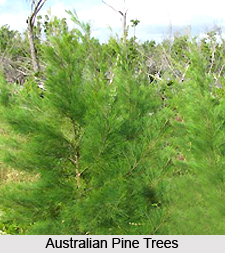
 Though Australian pine is preferred in India for its medicinal properties, it is basically originated from the coastal regions in the Andaman Islands and from Bangladesh. Not only in India, this tree was later introduced into many other tropical and subtropical locations worldwide. It is grown along the coasts of peninsular India and to a lesser extent in interior regions of peninsular India and northwestern India in windbreaks and in block plantations for fuel wood.
Australian pine is a tall, straight stemmed, evergreen tree that usually grows up to 25 metre in height. The branches bear clusters of long, slender, green needle like branchlets. The bark is grey or rusty brown in colour and the inner bark is cream-coloured. The leaves are whorled and reduced to minute scales. Flowers are dioecious. The male flowers lie in slender terminal spikes and the female flowers are in ovoid in shape and the heads are cone like. The tree bear fruits have hard surface, are of 1cm to 2 cm in diameter. The seeds are light and membranous. Flowering occurs in Australian pine between February and May in most parts of India.
Australian pine is used as a decorative tree in the parks and sometimes to decorate gardens and other piazza. The bark of this plant is highly regarded as an astringent. The decoction of the tree with the expressed juice of the seeds is used for treating chronic diarrhea and dysentery. The raw root as well as the dry root is used for medicinal purpose.
The powdered bark is used for treating acute acne, and the infusion of it is considered as a tonic. In the Philippines, the decoction is used as an emmenagogue if taken in large doses. The powdered branchlets are boiled in oil and used as a remedy for ear diseases. The extract derived from the mixture reportedly exhibits anti cancer activity and is given to treat colic and applied as a lotion for swellings. The powdered seeds are applied as a plaster to relieve headache. The fruit is also considered as having medicinal properties as they are crushed and reduced to powder and the powder is mixed with nutmeg to treat toothache.