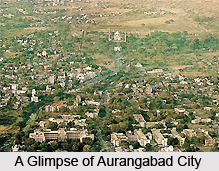
 Aurangabad is a city as well as a municipality in the district of Aurangabad, in the state of Bihar, which forms a part of the Indian subcontinent. Aurangabad was officially established in 1973, after being separated from then Gaya district. Magahi and Hindi are mainly spoken by the people of this region. The city is home to various tourists attractions which draws an impressive number of tourists to its land. Beautiful temples, historical places and Islamic pilgrimage centres are the highlights of Aurangabad. Good connectivity is another reason for the popularity of tourism in the city.
Location of Aurangabad
It is located east of Bodh Gaya at a distance of about 70 km and 140 km from Patna (capital of Bihar). It covers an area of 3,389 square kilometres. Aurangabad town serves as the administrative headquarters of this district.
History of Aurangabad
The history of Aurangabad is a part of history of the ancient Magadh and three-fourth of India`s early history is the history of Magadh. The speciality of Aurangabad is that, although it was ruled by the great Magadh Emperor, Ashoka, it culturally continued to have its own identity.
Later on, the scenic beauty of this region grabbed the attention of the people of Rajputana. They came here to offer pind "Dan" to their ancestors at Gaya but eventually decided to settle here.
Then it was controlled by Sher Shah Suri and under his system, the area became strategically important. After death of Sher Shah Suri; it came under imperial realm of Akbar. After the downfall of Mughal Empire, zamindars of Deo, Kutumba, Mali, Pawai, Chandragarh and Siris took the control of area.
Later, the British Government took steps to tighten their hold over the administration of the area. They separated the district of Gaya from Patna District, and Aurangabad was made Sub Division in 1865. It remained part of Gaya District till 1973.
Demography of Aurangabad
According to the 2011 India census, the city comprises a population of 2,511,243 out of which males constitute 52.20% and females 47.80%. 17.44% of the population is under 6 years of age. The literacy rate of Aurangabad is 72.77%, lower than the national average of 74.04%.
Attractions of Aurangabad
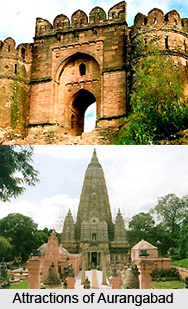
The city of Aurangabad shelters various tourist attractions which lure people from various part of the country. Some of the highlights of the city include Deo Kund, Umga, Amjhar Sharif, and Satbahini Mandir.
Deo Kund is an important historic place and is situated 10 km to the southeast of the border of Aurangabad and Jehanabad. Deo Kund is home to an ancient temple built in the honour of Lord Shiva. Umga is a pilgrim centre located 24-km to the east of the city. Umga shelters a Vaishnava temple which bears resemblance to the Sun temple built at Deo. Amjhar Sharif is a significant Islamic pilgrimage centre of Aurangabad. It houses an ancient grave of a Muslim saint - Hazrat Saiyadana Mohammad Jilani Amjhari Quadri. Satbahini Mandir is considered to be a temple of seven sisters. Every year during rainy season, a festival named "Adra Mela" is organised for 10 days in the vicinity of the temple. The fair draws a sizable number of crowds from all parts of the country.