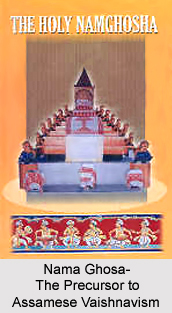
 Assamese Vaisnavism in Nama Ghosa thrives to be the magnum opus, the supreme achievement of Assamese Vaisnavite hymnic rapture. The Nama-ghosa, known also as Hajari-ghosa (a book of thousand couplets), occupies a unique place in the philosophical literature of Assam, nay of India. It is not only widely read but memorised and freely quoted as scriptural text, and thus, without a doubt, is an enduring prop of Assamese Vaishnavism. The philosophy of Madhavadeva as revealed in Nama-ghosa divides itself into different sections, namely, Maya, its nature and effects; cosmology; the Brahman; means of self-realisation; psychology of the Jiva; the goal of human life. The Assamese Vaishnavite literature, rich and varied, unique in style and language, is made up of the comprehensive literary and artistic genius of the authors. The literary heritage of this age comprises prose, poetry, drama, songs, etc., with distinctive characters of their own.
Spiritualism and Assamese Vaishnavism in Nama Ghosa
At the very outset Nama-ghosa explains that just as a dreaming man believes in the dream world which is his own creation, the individual self under the influence of Maya forgets its true nature-the pure self, and takes the unreal world, a creation of Maya, as real. That is why Madhavadeva says, "Thy Avidya (illusion), Oh Hari, has so bewildered and bewitched me that I do not know Thee in Thy essence (or Reality)." He clearly says all that is seen and extended in forms is nothing but Maya, and as such all of it should be rooted out from the mind. According to Hinduism, the creation of the world is not out of nothing. The Bhagavata says that the world is created, made to stay and dissolved by Krsna.
The Nama-ghosa solves the problem by saying that quite distinct from Purusa and Prakrti and yet the cause and upholder of the two is Paramesvara Narayana. In this world, the `inhabiter` or the `indweller` (Purusa) has two forms; the Ksara (perishable) and the Aksara (imperishable). The Supreme (Uttama Purusa) is otherwise called Paramatman, the Immutable, and the Lord upholds the three worlds having interpenetrated them. Thus there exists nothing but Brahman. Brahman alone is true in essence. He is all-pervading, in all space and in all time.
Madhavadeva says, "I bow down to Thee again and again, O Eternal, unstained one! Thou art the Reality, the everlasting Narayana, Siva, the Infinite without beginning, the Absolute without attributes. Thou art Bhagavanta, the Supreme Purusa, who has no antecedent or subsequent, neither beginning nor end. Thou art the only consciousness that thinkest out the whole universe." In short, Nama-ghosa maintains that the universe is nothing but a manifestation of God.
The Nama-ghosa says that Brahman is Eternal, Infinite Good, Benevolent, Permanent, All-pervading, one without a second, and beyond all change. In essence all apparent variety in name and form is nothing but Brahman. Brahman is beyond space, time or causation. It is absolutely pure, perfect, impartite, and indestructible. It is of the nature of pure consciousness. Anything which is not in the beginning and not at the end necessarily does not exist in the middle. Thus Brahman is like the vast expanse of the sky, the beginning or the end of which is unfathomed. It is Brahman that creates preserves and destroys the universe. The Brahman is both immanent and transcendental. It pervades all the three worlds and is yet apart from them. It is beyond the three qualities, beyond merit and demerit. It is Sama, Narottama, Nirvikara , Niranjana . Above all, Brahman is Sahajananda, Svarupananda , and Paramananda. Madhavadeva believed in Incarnations because his unmanifested and unqualified God may be brought to manifest Himself by virtue of devotion. Nama-ghosa speaks of the following ten Avataras (Incarnations): viz., Matsya, Kurma, Narasimha, Vamana, Parasurama, Halirama, Varaha, Sri Rama, Buddha, and Kalki. Thus the idea of Brahman of Brahmanising the soul is the keynote of Nama-ghosa`s thought and religion. According to Nama-ghosa, there are two steps to self-realisation: Bhakti and Grace of Guru.
Nama-ghosa considers the path of devotion to be the easiest of all. It is even superior to Jnana (Knowledge), Karma (Action), and Yoga (Contemplation). Knowledge and action cannot save one where devotion does not avail. It further says: "Contemplation is prescribed for Satya-yuga, Jnana for the Treta, Puja or ceremonial rites for the Dvapara; in the Kali-yuga, how ever, there is no other religion than chanting the name of Hari." Devotion alone helps one to cross the ocean of the world. This alone is the path to salvation. The devotional recitation of the name of Hari is regarded as the supreme religion of the Kali-yuga. He who wears constantly the invulnerable amulet of the name of Lord Rama and Lord Krishna is no more pierced by the strokes of the weapons consisting of the three gunas, Satva, Rajas and Tamas. The importance of the chanting of the name of Hari may be known from the fact that even the demon king Hiranyakasipu who put his son, Prahlad, to various tortures could not, however, remove a hair from his body because of the magic influence of the great amulet of Harinam. There is no necessity of reading various Sastras, the Vedas, Tantras etc., neither is there any need of visiting numerous sacred places. If you want to be free from the sufferings of the world, take to this means of your safety and salvation: utter constantly the word, Govinda.
The sumum bonum of this entire religious quest, according to Nama-ghosa, is the attainment of the state of Supreme Bliss. Liberation in Nama-ghosa does not mean the realisation of identity between God and the soul. It simply means the attainment of proximity to God, a state where the Jiva continues to chant the name of Hari. As a matter of fact, the devotee does not count liberation as valuable, but remains immersed in the ocean of the joy of Rama-Krsna nama. In other words, devotion to Krsna is the ocean of unthinkable infinite bliss. Thus those who are single-minded and intense in their devotion do not desire any other object but remain absorbed in the ocean of great joy consisting of Krsna`s name, than which there is nothing sweeter, nothing more beneficent or wonderful.
Besides, Nama-ghosa contains a large number of hymns on repentance and entreaty, self-discipline and self-reproach. In each of the hymns the lyric cry is predominant and ecstatic. The last few sections of the book serve as a litany consisting names of eulogistic for Lord Krsna. Nama-ghosa bears a universal appeal and is in perfect accord with the same class of sublime literature as the Upanisads and the Bhagavad Gita. Profundity of thought, unity of outlook, and music of diction mark Nama-ghosa as an outstanding work of art and a fitting monument to Madhavadeva`s philosophical and poetic genius Madhavadeva also composed a few one act plays (Ankijia nats): Cordhara, Pimpara Guchuva, Kotora Khelova, Bhusan Herova, Bhumi Lutiva, all presenting incidents of Krsna`s child life. These Ankiya nats of Madhavadeva contain fewer songs and Sanskrit slokas than those of Sreemanta Sankaradeva, and are therefore closer to the soil and wider in appeal.
Madhavadeva`s contribution to Assamese Vaishnavism
Madhavadeva came to be a very popular figure in the Vaisnavite movement through his Bargits. His piety found full expression in these impassioned devotional songs. Many of his Bargits strike deep notes of contrition and humility born of knowledge of the original sin, and of the spirit of self-surrender and consecration which alone can purge off the sin. Some of them contain idyllic descriptions of Vrnda: van with Child Krsna as the focus. These lyrics of Madhavadeva furnish lovely portraits of the childhood and adolescence of Krsna, and they reflect the thoughts and sentiments which animate childhood and youth. The supernatural and extraordinary personality of the Lord Krsna of the Bhagavata becomes quite human and simple in these Bargits. The incidents in Child Krsna`s life, associated as they were with Nature`s beauty, here become more lively and apposite. The eternal nature of the child is revealed in the boy Krsna, who becomes the child of today, absolutely simple, and ``his very smile rains a shower of nectar". The magic of Madhavadeva`s pen has worked a renaissance of wonder and given a new import and delight to familiar episodes.
Assam Vaishnavism is based upon absolute devotion to God with a spirit of self abnegation so as to realize in the end that one live, move and have our being in and for God alone. Total surrender to God, absolute dedication to the service of God and His creatures, to feel the presence of God everywhere as the in-dwelling spirit, to see God in everything and everything in God, and to listen to and chant the Names and qualities of God with absolute devotion are some of the basic tenets of Assam Vaisnavism. Sankaradeva narrated in beautiful verses the Puranic stories to establish the power of absolute devotion to God in his masterly work Kirtana-ghosa and Madhavadeva expounded in beautiful verse-forms his spiritual experiences and the philosophical basis of the bhakti-cult in his great work Nama-Ghosa.