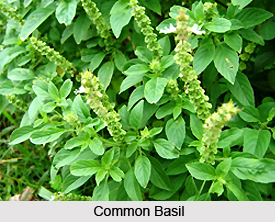
 Arjaka is a type of Tulsi plant that is widely grown in India. Scientifically it is called Ocimum americanum while Arjaka is its Sanskrit name. Apart from this it is also known as Babuitulsi in Hindi and Bengali; Dhalatulasi in Oriya; Marva in Marathi, Bhutulasi in Telugu, Kattutulasi in Malayalam, Janglitulasi in Urdu and Tirnutpatchi in Tamil. Arjaka is an erect, sweet scented herb that grows upto 90cms in height. The stems and branches of this plant are either green or purple. The leaves are ovate, apex and faintly lobed or toothed. Arjaka bears flowers in more or less closely set whorls in spicate racemes. The
Bracts are stalked, shorter than the calyx, ovate and acute. The fruits are narrowly ellipsoid, black, pitted and mucilaginous when wet.
Arjaka is a type of Tulsi plant that is widely grown in India. Scientifically it is called Ocimum americanum while Arjaka is its Sanskrit name. Apart from this it is also known as Babuitulsi in Hindi and Bengali; Dhalatulasi in Oriya; Marva in Marathi, Bhutulasi in Telugu, Kattutulasi in Malayalam, Janglitulasi in Urdu and Tirnutpatchi in Tamil. Arjaka is an erect, sweet scented herb that grows upto 90cms in height. The stems and branches of this plant are either green or purple. The leaves are ovate, apex and faintly lobed or toothed. Arjaka bears flowers in more or less closely set whorls in spicate racemes. The
Bracts are stalked, shorter than the calyx, ovate and acute. The fruits are narrowly ellipsoid, black, pitted and mucilaginous when wet.
This species of tulsi is quite common in Indian sub-continent. These are abundantly found in the cultivated fields and wastelands in the plains or the lower hill of India. Besides this, Arjaka is also found in countries like, Sri Lanka, Java, western Asia and tropical Africa.
Arjaka is known for its medicinal uses. In Ayurveda, this plant is used to treat heart and blood diseases, biliousness, leucoderma and itching. On the other hand, Unani medicine utilises it to treat chronic joint pain, inflammation, enlarged spleen and asthma besides diseases relating to brain and heart. The juice of Arjaka is useful for treating toothache, earache and headache, and mixed with camphor it is used to stop nosebleeds. A decoction of the plant is taken internally to relieve coughs and fever, and that of the leaves for treating dysentery, and as a mouthwash for relieving toothache. The leaf juice is a popular remedy for ringworm, and is also given to children for treating cold and bronchitis. In north-eastern Karnataka the leaves, mixed with black pepper and garlic are given to patients to overcome fits.
The seeds are also used for treating gonorrhoea, diarrhoea and chronic dysentery; their decoction is used as eyewash to relieve inflammation among the Kondhs of south-western Orissa. A cold infusion of the seeds is reportedly used by rural inhabitants of Bhavnagar District in Gujarat to treat painful urination. The plant yields a volatile oil that is used as a perfume for soaps and cosmetics.