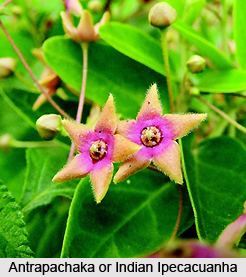
 The botanical name of Antrapachaka plant is Tylophora indica (Burm. f.) Merr. The common names of this medicinal plant vary according to the various regions of India. Some of the major common names are Ananthamul, Antamul in Bengali, antamul, jan-gli-pikvam in Hindi; mendi, mulini in Oriya; and antrapachaka, arkaparni, gand-hana, lataksiri, moolinee, shwasaghni in Sanskrit.
The Antrapachaka plant is a branching climber or shrub. It is up to 1.5 m tall with a short, knotty rootstock and abundant fragile, fibrous roots possessing a pleasant aromatic odor. Leaves are ovate-oblong with a rounded base. Flowers of this medicinal plant are greenish-yellow in colour to the outside and purple to its inside. Fruits are generally 10 cm long and 5 cm wide with broadly ovate seeds.
The Antrapachaka plant is cultivated in India for its medicinal uses. All parts of this plant are used for the treatments of different diseases. The roots are used for the treatment of chronic bronchitis and for whooping cough. These are also useful for reducing lochia, and for relieving pain due to gout. They are considered to be highly effective as an alterative and anti rheumatic. The powdered roots are used for treating intermittent malarial fever. In some parts of India, the root paste is used as an external application to the eyelids for treating jaundice. The leaves are used as diaphoretic, emetic and expectorant. These are also applied in powdered form for treating diarrhea and dysentery. A decoction of leaves or roots is useful for treating bronchial asthma, bronchitis and dysentery.
This article is a stub. You can enrich by adding more information to it. Send your Write Up to content@indianetzone.com