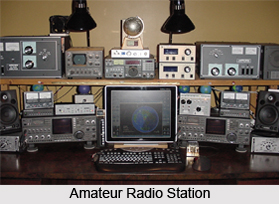
 Amateur radio is practiced by more than 16,000 licence holders in India. Also known as ham radio, it uses certain frequency spectra and serves the purposes like non commercial message exchange, self-training, private recreation, wireless experimentation, emergency communications and many others which do not involve monetary or other similar reward. Wireless and Planning and Coordination Wing (WPC) which is a branch of the Ministry of Communications and Information Technology grants licences for amateur radio which are valid up to five years. The frequency bands or frequency spectrum is also allotted by the WPC. Five licence categories have been listed under the Indian Wireless Telegraphs (Amateur Service) Rules, 1978.
Various licence categories enjoy different privileges in addition to the allotment of frequencies which corresponds to different emission modes and input DC power. Frequency bands of amateur radio in India refer to the International Telecommunication Union (ITU) radio band designation and are measured in megahertz. The wavelength of the band is measured in centimetres and metres. The type of band depends on the radio frequency classification.
Types of Amateur Radio Frequency Bands
Classification of radio frequency signals is done by the International Telecommunication Union according to an internationally agreed system. Different types of radio emission are categorized as per its bandwidth, nature of the modulating signal, method of modulation and type of information transmitted on the carrier signal. The characteristics of the signal decide the type instead of the type of transmitter used. The emissions are designated in the form of BBBB 123 45 in which bandwidth of the signal is signified by BBBB, 1 signifies the letter that indicates the type of modulation used, 2 denotes the digit corresponding to the type of modulating signal, 3 is the letter indicating the type of information transmitted, 4 is the letter denoting the practical details of the transmitted information and 5 is the letter representing the method of multiplexing. The 4 and 5 fields are not obligatory.
Amateur Radio Frequency Bands in India
| Band | Frequency (MHz) | Wavelength | Type |
| 6 | 1.820-1.860 | 160 m | MF |
| 7 | 3.500-3.700 | 80 m | HF |
| 7 | 3.890-3.900 | 80 m | HF |
| 7 | 7.000-7.200 | 40 m | HF |
| 7 | 14.000-14.350 | 20 m | HF |
| 7 | 18.068-18.168 | 17 m | HF |
| 7 | 21.000-21.450 | 15 m | HF |
| 7 | 24.890-24.990 | 12 m | HF |
| 7 | 28.000-29.700 | 10 m | HF |
| 8 | 50.000-54.000 | 6 m | VHF |
| 8 | 144-146 | 2 m | VHF |
| 9 | 434-438 | 70 cm | UHF |
| 9 | 1260-1300 | 23 cm | UHF |
| 10 | 3300-3400 | 9 cm | SHF |
| 10 | 5725-5840 | 5 cm | SHF |
This article is a stub. You can enrich by adding more information to it. Send your Write Up to content@indianetzone.com