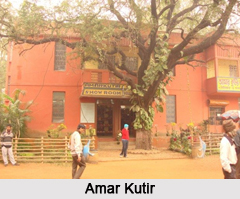
 Amar Kutir was once a place of refuge for independence movement activists in India and Bangladesh. It has been turned into a cooperative society for the promotion of arts and crafts.
Location of Amar Kutir
Amar Kutir is located on the banks of the Kopai River, about 15 kilometers from Shantiniketan in Birbhum district in the Indian state of West Bengal.
History of Amar Kutir
In 1922, on an invitation from Rabindranath Tagore, Mohandas Karamchand Gandhi (Mahatma Gandhi) just released after imprisonment for political activities, visited Shantiniketan. Sushen Mukherjee, a young man, met him there. Sushen Mukherjee had been associated with the revolutionary movement for India"s independence for some years. His meeting with Gandhi led to the setting up of Amar Kutir in 1927. Sushen Mukherjee was the founder of Amar Kutir. He was born late in the eighteenth century, hailing from a remote suburb of Kolkata, West Bengal. Before Independence of India, Mahatma Gandhi, Netaji Subhas Chandra Bose, Sardar Ballav Bhai Patel and many other freedom fighters, visited Amar Kutir.
Art and Craft of Amar Kutir
Amar Kutir was founded by Sushen Mukherjee. There he came across with the different shades of people. He learned the tricks and trades of waxing, cracking and printing, hitherto popularly known as Batik Print on fancy leather goods such as ladies` handbags, purses, brief-cases, side bags etc. He was the pioneer in this type of artifice trading and which, of course, he mastered through intermingling with traders visiting India from Malayasia, Indonesia in the late thirties and early forties. During his years in prison Mukherjee met several revolutionary leaders, notably Moni Ganguly and Panna Lal Dasgupta. The prisons of British authorities were at that time hot beds of Marxist discussion and training. From 1938 when the British Government relaxed its rules and started releasing many of the revolutionaries from prison, they started living and working in Amar Kutir. They were instrumental in organizing night classes and spreading Marxist ideas amongst the rural masses. When the Second World War broke out in 1939, many of the revolutionaries left Amar Kutir and were directly involved in organizing peasant movement in the villages. Many of them were active during the Quit India movement in 1942.