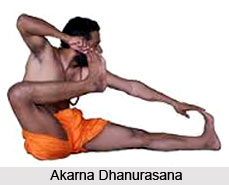
 Akarna Dhanurasana is one of the important yogic exercises, which ensures several benefits for the human body system. This asana involves another system of pulling the leg which gives the impression of a bow with an arrow to be shot and hence, the name Akarna Dhanurasana. Akarna refers to being stretched.
The name `Akarna Dhanurasana` is literally translated towards the ear bow pose. Akarna Dhanurasana in translation from Sanskrit `Karna` means ear, the prefix `A` means towards; or near, Dhanu means "bow" and asana means "pose". Holding the toes (alternately) with hands, pulling them (the toes) up to the (corresponding or opposite) ears, (and thus) assuming the shape of a stretched bow. This yoga posture exerts great strain and one can not maintain it for long but with practice one can maintain it for up to 30 seconds. This asana is quite a complicated maneuver hence it is advisable to perform under the supervision of a yoga master until one is able to perform this comfortably with confidence.
Practice of Akarna Dhanurasana:
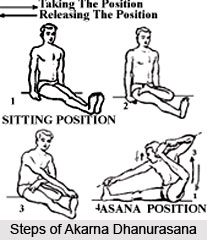
•Bend the left leg in knee and keep the foot on the thigh of right leg. Keep the right leg straight.
•Hold the big toe of the left leg with left hand, and that of the right leg with the right hand.
•Start exhaling and inhaling lifting the left leg with the left hand and pull it up to the left ear, and stabilize it at that point.
•Continue normal breathing.
•After few seconds come back to the original position.
•Now holding the right leg at big toe by fore finger and thumb of right hand raise it up to the right ear.
•Again after few seconds come back to the original position. This completes one round of Akarna-Dhanurasana.
 Benefits of Akarna Dhanurasana:
•Akarna dhanurasana is a good posture to remove the pain of back and lumbar region.
•This asana increases the elasticity of thigh joint and shoulder.
•It is also useful in arthritis and rheumatic condition.
•It helps in regularizing the menstrual cycle in most women.
•Breathing is greatly enhanced with this pose as it increases the capacity of the lungs to retain oxygen.
•It ensures improvement of concentration.
•It betters the process of digestion and clears constipation.
•It strengthens the legs and builds up cores muscles.
•It also helps in healing pain in the lower areas of the abdomen and also relieves pain in the larger intestines.
Precautions during Akarna Dhanurasana:
•Beginners should not try this asana when they are alone.
•This asana is also not suitable for the pregnant women.
•Persons with weak waist joints should not do this asana as it brings great strain to the joints.
•People with spinal injuries should also avoid this pose.