
The fluctuations of consciousness need to be controlled through repeated yogic practice and this is the very central theme of the twelfth yoga sutra of Patanjali yoga. Practice and detachment are the means to still the movements of consciousness therefore stand as the kernel theme of the yoga sutra.
Abhyasa repeated practice
Vairagyabhyam freedom from desires, detachment, renunciation
Tannirodhah their restraint
Practice and detachment are the means to still the movements of consciousness.
The fluctuations of consciousness, painful or non-painful, described in Sutras 5 and 6, needs to be controlled through repeated yogic practice. Mental strength must also be garnered, to achieve detachment and freedom from desires.
Study of the consciousness and stilling it is practice (abhyasa). Elsewhere (11.28) Patanjali has made use of another word - anusthana. Abhyasa expresses the sense of mechanical repetition, while anusthana connotes devotion, dedication and a religious attitude. Repeated effort made with an in-depth understanding of the art and philosophy of yoga and with perfect communion of body, mind and soul is not a mechanical practice, but a religious and spiritual one.
Practice is the positive aspect of yoga, detachment or renunciation (vairagya) is the negative. The two equilibrise each other like day and night, inhalation and exhalation. Practice is the path of evolution - detachment and renunciation the path of involution. Practice is demanded in all the eight limbs of yoga. Evolutionary practice is the forward march towards discovery of the Self, necessitating yama, niyama, asana and pranayama. The involutionary path of renunciation necessitates pratyahara, dharana, dhyana and samadhi. This inward journey disengages the consciousness from external objects.
Patanjali`s practice represents the ha or `sun` aspect, and renunciation the ha or `moon` aspect of hatha yoga. In hatha yoga, ha symbolises the life-force and tha, the consciousness. Ha also stands for the very being - the seer, whereas tha is the reflected light of the seer, symbolising citta. Through Hatha yoga these two forces are coalesced, and then merged in the seer.
To be proficient in yoga, yama and niyama must be observed carefully all through the yogic sadhana. This is abhyasa. The casting away of ideas and actions which obstruct progress in sadhana is named vairagya.
As it is known, consciousness becomes involved with the objects perceived, and identifies with them, taking the seer with it. Then the seer becomes subordinate to the vacillating mind. The eight aspects of yoga, are illustrated as a means to stop the fluctuating of the intelligence and to learn exact understanding. Though the first four concerns with practice and the others to renunciation, practice and renunciation are interdependent and significant to the same degree. Without control, the forces yielded by practice would spin out of control and could ruin the sadhaka. At the elevated levels, vairagya without abhyasa could lead to stagnation and inner decay. The first four aspects are considered a process of building-up, and the last four one of inner consolidation. Once the initial lamasic nature moves towards a dynamic state, restraint becomes necessary for one`s own inner security.
Vairagya is a practice through which the sadhaka learns to be liberated from desires and passions and to encourage non-attachment to things, which holds back his pursuit of union with the soul.
Abhyasa vairagyabhyam tannirodhah
This is the twelfth yoga sutra contained in Patanjali Yoga Sutras.
Recently updated articles in Yoga
Khanda Manda Yoga
Khanda Manda Yoga is a difficult form of yoga where the Yogi cuts off his own arms and legs with a sharp cleaver, that is axe-like knife, and throws t...

Kaivalya Pada
Kaivalya Pada, the fourth chapter of Patanjali Yoga Sutra denotes an absolute, indivisible state of existence of the Yogi. The Kaivalya Pada is someti...
Vibhuti Pada
Vibhuti is the Sanskrit term for “power” or “manifestation.” In this third chapter, Patanjali introduces the final three limbs of Aṣṭanga Yoga, collec...

Sadhana Pada
Sadhana Pada in Patanjali Yoga Sutra denotes the idea of practicing yoga that leads to spiritual illumination. Sadhana, the Sanskrit term for “practic...
Samadhi Pada
Samadhi Pada is the first chapter of Patanjali Yoga Sutra. In this chapter, the author explains the essence of yoga, the nature of samadhi, and the me...
Related articles in Yoga
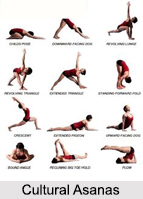
Cultural Asanas
Cultural Asanas refer to the daily physical exercise postures that train the body and mind in Yoga Practice.
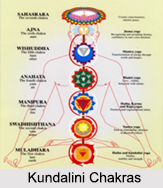
Kundalini Chakras
Kundalini Chakras are psychic energy centres or vortices, which connect between our psychic and physical energy systems.
Patanjali Yoga Sutras
Patanjali’s Yoga Sutras presents a foundational guide to the philosophy and practice of yoga. Through concise aphorisms, it outlines the nature of the...
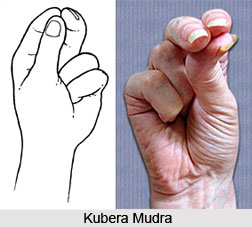
Kubera Mudra
Kubera Mudra, a form of Hatha Yoga, leads to the elevation of mental peace and physical relief by proper practice and cleanses frontal sinuses.