 Districts of Pune Division in Maharashtra are concentrated with the areas of Pune District and the Pune City. Some of the districts of Pune Division in Maharashtra are Kolhapur district, Pune City and the Pune District, Sangli District, Satara District and Solapur District.
Kolhapur District
Kolhapur district is in Maharashtra state. The city of Kolhapur is the district headquarters. As of 2011, the district had population of 3,876,001, of which 33 percent are urban.
Pune District
Pune District is situated in Maharashtra. Pune city is the district headquarters. In the most recent census on 2011, the total population of the district was 9,426,959, making it the fourth most populous district in India. The urban population in Pune City and the Pune District comprises 58.08% of the total population. The current population of Pune urban agglomerate is over 5 million.
Sangli District
 Sangli District is a district of Maharashtra State in west-central India. Sangli City is the district headquarters. The district has the 24.51 percent of people which are concentrated in the urban world. Sangli and Miraj are the largest cities. The industrial town of Kirloskarwadi is also located in the Sangli District. Industrialist Laxmanrao Kirloskar started his first factory here. It is known as the sugar bowl of India due to its high sugarcane productivity. Sangli District is one of the most fertile and highly developed districts in Maharashtra. Sangli District is very popular as a political powerhouse in the state. Sangli District has provided many popular politicians and bureaucrats until now. Sangli has a rich history and cultural heritage. People often refer to Sangli District as the "Heaven of Farmers".
Satara District
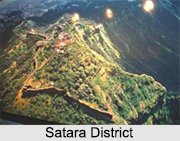
Satara District is a district of Maharashtra with an area of 10,480 square km and a population of 3,003,741 of which 14.17% were urban. Satara is the capital of the district and other major towns include Wai, Karad, Koregaon, Koynanagar, Rahimatpur, Phaltan, Mahabaleshwar and Panchgani. This district comes under Pune Administrative Division along with Pune, Sangli, Solapur and Kolhapur. The district of Pune bounds it to the north, Raigad District bounds it to the North-West, Solapur District the east, Sangli District to the south, and Ratnagiri District to the west.
Solapur District
Solapur District is a district in Maharashtra state of India. The city of Solapur is the district headquarters. It is located on the south east edge of the state and lies entirely in the Bhima and Seena basins. The Bhima River drains the entire district as the lifeline of the Solapur.