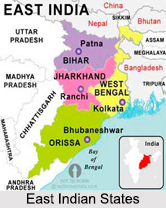
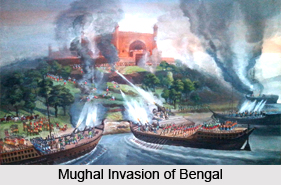
 Bengal Subah was a state of the Mughal Empire encompassing modern Bangladesh and the Indian states of West Bengal, Bihar and Odisha between the 16th and 18th centuries. Now West Bengal, Bihar and Odisha are under now in independent Indian states.
Establishment of Bengal Subah
Bengal Subah was established following the dissolution of the Bengal Sultanate, when the region was absorbed into one of the largest empires in the world. The Mughals played an important role in developing modern Bengali culture and society. By the 18th century, Mughal Bengal emerged as a quasi-independent state. Mughal Emperor Akbar introduced Bengali New Year.
Defeat of Bengal Subah
After the defeat of Sultan Daud Khan Karrani at Rajmahal in 1576, Emperor Akbar announced the creation of the Subah of Bengal. By the 17th century, the Mughals subdued opposition from the Baro-Bhuyans landlords, notably Isa Khan. The region was integrated into a powerful and prosperous empire; and shaped by imperial policies of pluralistic government.
Mughal Empire of Bengal
The Mughals built a new imperial metropolis in Dhaka from 1610, with well-developed fortifications, gardens, tombs, palaces and mosques. It served as the Mughal capital of Bengal for 75 years. The city was renamed in honour of Emperor Jahangir. Dhaka emerged as the commercial capital of the Mughal Empire, given that it was the centre for the empire`s largest exports: cotton muslin textiles.
Naval Business in Bengal
In 1666, the Mughal armed and naval forces conquered Chittagong from the Portuguese and the Arakanese. The city was renamed as Islamabad. The Chittagong Hill Tracts frontier region was made a tributary state of Mughal Bengal and a treaty was signed with the Chakma Circle in 1713.
Later era of Bengal Subah
It was in between 1576 and 1717, Bengal was ruled by a Mughal viceroy. The members of the imperial family were often appointed to the position, with two Bengal viceroys becoming the Mughal Emperor themselves. In 1717, the Mughal Court upgraded the viceroy`s position to the hereditary Nawab of Bengal, establishing the province as a quasi-independent state under imperial suzerainty.
Related Articles
West Bengal
History of West Bengal
Medieval History of Bengal
Mughal Dynasty
Mughal Emperors
Economy of Mughal Empire
Administration of Mughal Dynasty
History of Kolkata
Medieval History of Kolkata
Nawabs Of Bengal