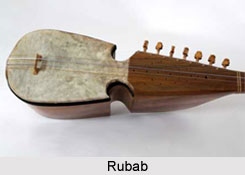
 Rubab, robab or rabab is actually a lute like musical instrument that originated in Afghanistan and North West Pakistan, but is also played in the neighbourhood nations. It derives its name from Arab Rubab that means played with a bow but the Central Asian Instrument is plucked and is uniquely different in construction. The Rubab is essentially used by Pashtun, Tajik, Kashmiri and Iranian Kurdish classical musicians.
The Rubab is a short necked lute whose body is carved out of single piece wood, with a membrane, covering the hollow bowl of sound chamber, on which the bridge is positioned. It has three melody strings tuned in fourths, three drone strings and 11 and 12 sympathetic strings. The instrument is also made from the trunk of mulberry tree, the head from an animal skin like a goat skin, and the strings either gut (from the intestines of young goats, brought to the size of thread) or nylon.
The Rubab is also called "the lion of instrument", and is one of the two national instruments of Afghanistan along with Zerbaghali. This instrument often features in the classical Afghan music. It forms as a key component, and elsewhere it is called Kabuli Rebab.
It is the ancestor of South Asian sarod though - unlike the sarod, it is a fretted instrument. When the Muslim musician Mardana became the first disciple of Guru Nanak the plucked rabab became an essential component of Panjabi hymns though, once again, though it derived its name from the rabab the Punjabi instrument adopts a different method of construction.
The rabab is attested from the 7th century CE. It is mentioned in Old Persian books, and many Sufi poets mention it in their poems. It is the traditional instrument of Khorasan and today it is widely used in countries, such as Afghanistan, Pakistan, Iran, India, Tajikistan, and Uzbekistan.
The rubab holds as the first instrument used by Sikhism, it was used by Bhai Mardana the companion of Guru Nanak whenever a shabad was revealed to Guru Nanak he would sing it and Bhai Mardana would play it on his rubab he was known as a rubabi. The rubab playing tradition is still carried on by some sikhs such as Namdharis is understood as Sikh music.
In Tajikistan, a similar but in a way different and distinct Rubab-i-Pamir (Pamiri Rubab) is played having a shallower neck and body. The rubab of the Pamir area has six gut strings, one of which, rather than running from the head to the bridge, is close partway down the neck, alike to the fifth string of the American banjo