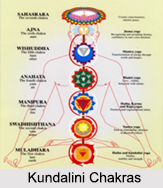
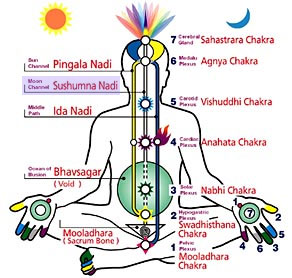
 Kundalini Yoga affirms the presence of the nerve channels known as the Ida, Pingala and the Sushumna, which is the innermost channel in human body. Sushumna is the highest and most sought by the Yogins. Sushumna is the central channel and is associated with the river Saraswati that is running up the body from just below muladhara chakra to Sahasrara chakra, which is at the crown of the head.
The central channel is the channel of ascent, it is the power, which sustains our evolution and guides us, consciously or unconsciously, towards the higher awareness of the Sahasrara. Sushumnas is medium for the kundalini energy that runs along our spine and up to the crown of our head, it flows directly upwards and downwards, between Ida and Pingala, coursing through the charkas. The mouth or opening to the sushumna channel, as well as chitrini nadi and other finer nadis that are within the sushumna, situated at the root (muladhar chakra), located at the perineum, between the genitals and the anus.
Prana flowing in Sushumna brings a great feeling of joy and can easily be confused with Kundalini Awakening. As one can feel the tranquility, along with the warmth flowing through the levels of the spine, this calmness is very appealing but there is a difference between the flow of Prana through Sushumna and full Kundalini Awakening, where that Kundalini energy itself rising. Both Prana and Kundalini are forms of the universal energy of Shakti, though here, at this stage, it is still Prana that is flowing in Sushumna. However, if this knowledge and ability to focus on sushumna nadi was not gained until death, then the consciousness of this person will come out of the body through a different nadi, and will be integrated in one of the numerous worlds of the expression, according to the level of vibration and spiritual evolution.