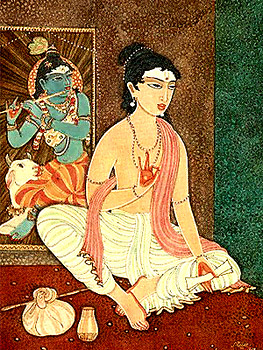
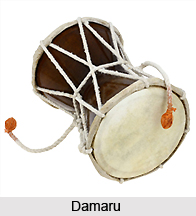
 Damaru is a percussion musical instrument of India with a distinct religious significance. Just like the Veena of Goddess Saraswati and the flute of Lord Krishna, the Damaru is the drum of the divine dancer, Lord Shiva. Indeed, the elemental vibration of creation was the sound of the Damaru or Dhakka of Lord Shiva. From this originated also all the sounds of speech and music. Historically, however, the Damaru and its variations like the Dhakka and the Dimdima are found mentioned in Amarakosa (fifth century AD), Mahasutasoma, Jataka Astadhyayi (seventh century AD) and so on. Old Tamil Literature also has references to Damarukam. Some of the names by which this class goes under are Damru, Dambru Kudukuduppai, Budbudke and Budbudukalu, the last two in south Indian languages. Though it is heard rarely in the more developed folk music, it is a companion of wandering minstrels, soothsayers and monkey-men.
Usually the length is of 10 cm, the diameter varying to suit the Lengti. The height of the Damaru ranges from a few inches to a little over a foot. The shell is made of wood or brass: in unusual cases, as in the Lamaic, the body is of two human skulls fixed hind to hind. The drum faces of leather are attached to metal or bamboo rings and mutually connected by cotton or hemp threads which are tightened with another thread going round them at the region of the waist. Two cotton strings knotted at the free ends are tied at the constricted part of the body. The Damaru is played with one hand. The strikers are typically beads fastened to the ends of leather cords around the waist of the Damaru. Knots in the leather can also be used as strikers. The player holds the instrument at the waist and jerks it. This action makes the knots strike or clap the faces, producing the sound. This is why this class of membranophones is often called the clapper drums. By pressing or loosening the braces, different rhythmic and pitch effects are obtained.
The Damaru, due to its association with Lord Shiva, is considered a powerful instrument and the playing of this drum is associated with spiritual energy.