
 Literature is a part of the heritage of India. Indian literature exists in varied languages. Various Indians skilled in writing have contributed in creating this part of India"s heritage in the form of stories, novels, prose, essays, etc. Assamese language writers are no exception in this regard. Some of the Assamese writers and their works are given below.
Assamese Writers
The names of some of the Assamese Writers are Lakshminath Bezbaroa, Ananda Chandra Barua, Parvati Prasad Baruva and Bhubanmohan Baruah.
Introduction
Literature is a part of the heritage of India. Indian literature exists in varied languages. Various Indians skilled in writing have contributed in creating this part of India"s heritage in the form of stories, novels, prose, essays, etc. Assamese language writers are no exception in this regard. Some of the Assamese writers and their works are given below.Lakshminath Bezbaroa
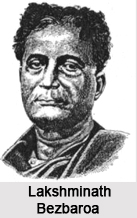
Lakshminath Bezbaroa is recognized as a writer from Assam. He is considered to be a pioneer of modern Assamese literature. He has displayed his versatility in writing poetry (like Kodom Koli and Podum Koli), novel (like Podum Kunwori), short stories (like Surobhi and Xadhukothaar Kuki), children`s literature (like Junuka), essays (like Barbaruar Buloni), comic plays (like Litikai), plays (like Joymoti Kunwari), biographies (like Sri Sri Shankardev) and books in English (like Rasalila of Sri Krishna).
Ananda Chandra Barua
Ananda Chandra Barua, also known as Bokulbonor Kobi is recognized as an Assamese writer, playwright, journalist and actor. Barua has written poems like Porag, Ranjan Rashmi, Paporir Porimal, Bokul Bonor Kabita and Sei Nimati Puware Pora and dramas like Bijoya, Bisorjan, Nal Damayanty and Komota Kuwori. He has written sonnets like Puspak and novel like Asomiya Deka. He has also translated plays and poems.
Parvati Prasad Baruva
 Parvati Prasad Baruva, also known as the Geetikavi is a revered poet, lyricist and dramatist from Assam. He is recognized as an icon of Assamese literature and the culture of Assam. Film making also forms a part of his identity and he is recognized as one of the early pioneering filmmakers of Assamese cinema. What can be comprehended from his writings is that Baruva has made simple and sensitive use of the Assamese language. He is credited with the creation of a book of poems, book of songs, book of bongeets, etc.
Bhubanmohan Baruah
Bhubanmohan Baruah is recognized as an Assamese novelist and short story writer. Some of his contributions to Indian literature are Asimat Jar Heral Seema, Puwoti Tora, Joya Mohol and Urmilar Sokulu.
Banikanta Kakati
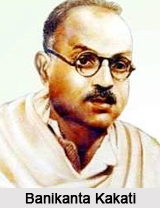
Banikanta Kakati is recognized as an Assamese writer, critic and scholar. Some of his writings are Purani Kamrupar Dharmar Dhara, Purani Asamiya Sahitya, Sahitya Aru Prem and Kalita Jaatir Itibritta.
Jyoti Prasad Agarwala
Jyoti Prasad Agarwala is recognized as a playwright, poet, songwriter and filmmaker from Assam.
Agarwala has written plays like Sonit Kunwori, Karengar Ligiri and Rupalim. Poems contributed by him are Jyoti Raamaayon and Luitor Paaror Agnixur. Songs written by him are called Jyoti Xongit.
Other Assamese Male Writers
Some of the other Assamese Writers are Syed Abdul Malik, Satyanath Bora and Saurabh Kumar Chaliha.
Women Writers in Assamese Literature
 Early Women Writers in Assamese Literature have made considerable and consistent contributions to literature down the ages. From the early days Assamese literature has shown it to be a literature of men and it is true that male domination of education and letters was present here as it was in literature the world over. However, despite adverse circumstances, lack of opportunity, and even lack of proper education, Assamese women were able to make their presence felt in the field of literature. Most of the earliest women writers were able to embark on their literary pursuits because they were born into the families that were progressive and allowed for the higher education of women which was not encouraged at the time.
Among the earliest women who have contributed in the field of Assamese literature were those who have had the advantage of being born into literary, progressive families that allowed them to receive educations superior to those of other women. One member of Anandaram Dhekiyal Phookan`s family who made a mark on her own was his daughter Padmavati Devi Phookanani (1853-1927). Her Sudharmar Upakhyan (Sudharma`s Tale, 1884) can be considered to be the second novel by an Assamese writer, male or female. The novel relates the travels and trials of Sudharma, her husband, and their friends amidst settings which are reminiscent of early classical tales. She was a poet and critic and even wrote a children`s book, Hitosadhika. She wrote a number of articles that display her feminism in journals of her time, such as Baheen and Baheen. Most notable were her ideas on the conditions of women. She was widowed at 32, and her article in Baheen, "Bidhoba," speaks of the harsh life of the widow in Indian society. She comments on the general condition of women in an article she sent to the Sahitya Sabha (the Assamese Literary Association) called "Samajot Tirutar Sthan" (Women`s Place in Society). Gunabhiram Baruah`s daughter Swarnalata Baruah (1871-1932), too, contributed articles to Assam Bandhu Bijuli, and she wrote Aahi Tiruta while quite young. Unfortunately, her family life proved too difficult and tragic for her to be able to continue writing.
In the early twentieth century, three women who became known on their own strength were Dharmeswari Devi Baruani, Jamuneswari Khatoniyar, and Nalinibala Devi. Kabya Bharati.
Dharmeswari Devi Baruani (1892-1960)
Dharmeswari Devi Baruani rose above immense physical and mental difficulties to become known as a poet. Soon after her marriage to Durganath Barua, Dharmeswari Devi was struck by an incapacitating illness that left her an invalid. Poetry and the love and support of her husband, which she expressed in her poetry, sustained her, but she was soon widowed. From a life such as this and a body that was gradually losing its abilities, she made her poetic voice heard in her works which are as follows- Phulor Sorai (1929), Pranor Parash (1952), and Ashrudhan Aru Jivantari (1963), all of which were influenced by Romanticism. Though she takes her imagery from nature, her poetry reveals a strong devotion to the Creator. In 1956, she received the title "Kabyabharati" from the Assam Sahitya Sabha.
Dharmeswari Devi Baruani has two published collections of poems - Phular Sarai (The Basket of Flowers) and Pranar Paras (The Soul`s Touch). Both are expressions of a profound pantheism and the desire of the individual soul to` get merged in the universal soul. The poetess does not believe that God resides in heaven, which to her is a figment of man`s imagination. He is present in all things, both great and small.
The divine spirit and motion she finds everywhere and in all the objects of the world, and it is these which endow everything with peerless beauty and inexhaustible meaning. Though an invalid, and widowed early in life, Dharmeswari has none of the melancholy of Nalinibala Devi. With robust optimism she awaits the day of supreme union. Hence her poetry, issuing from a heart truly deep and passionate, is the sweet reflection of silent womanly self-surrender, love-lorn tenderness and sincere devotion, undimmed by the clouds of adulation or controversy. Although her subjects are limited in range to the most common themes like God, nature and the human heart, she possesses the sensitiveness and insight to endow them with fresh beauty and lovely diction. There is in her poems a deep sympathy and reverence for life and worldly things.
Dharmeswari Devi Baruani has two published collections of poems - Phular Sarai (The Basket of Flowers) and Pranar Paras (The Soul`s Touch). Both are expressions of a profound pantheism and the desire of the individual soul to` get merged in the universal soul. The poetess does not believe that God resides in heaven, which to her is a figment of man`s imagination. He is present in all things, both great and small.
The divine spirit and motion she finds everywhere and in all the objects of the world, and it is these which endow everything with peerless beauty and inexhaustible meaning. Though an invalid, and widowed early in life, Dharmeswari has none of the melancholy of Nalinibala Devi. With robust optimism she awaits the day of supreme union. Hence her poetry, issuing from a heart truly deep and passionate, is the sweet reflection of silent womanly self-surrender, love-lorn tenderness and sincere devotion, undimmed by the clouds of adulation or controversy. Although her subjects are limited in range to the most common themes like God, nature and the human heart, she possesses the sensitiveness and insight to endow them with fresh beauty and lovely diction. There is in her poems a deep sympathy and reverence for life and worldly things.
Jamuneswari Khatoniyar (1899-1924)
Whereas Dharmeswari Devi lived a long life of much suffering; Jamuneswari Khatoniyar (1899-1924) accomplished what she did in a life that ended at age twenty-five. She was educated privately, since a public school education was not allowed for the young girls of the time. Jamuneswari went on to pass her middle school examination with her private education, soon after which she sought to remedy the inequality in education by opening, and teaching in, a primary school for girls. The school, Mudoigaon Girls School, still remains as a testimony to her reformatory zeal. In 1920, she married the poet Bhairab Chandra Khatoniyar and died four short years later. But in those four years she created a forum for the expression and exchange of ideas by establishing Juroni Sabha, a religious and literary gathering at her house each evening. She left one volume of collected poems, Arun (1919), and published poems in Baheen.
Nalinibala Devi (1898-1977)
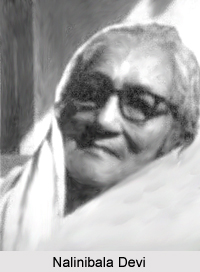
Nalinibala Devi is probably the best-known female poet of her era. She wrote her first poem, "Pita," when she was 10 years old. Though widowed at a very early age in an era that considered widowhood the end of a constructive life, Nalinibala rose above this misfortune and began her life as a prolific poet and writer. Her poetic works include Sandhiyar Sur (1928), Saponar Sur (1943), Parashmoni (1954), Alakananda (1967), and Jagriti (1962), among others. She was awarded the Sahitya Akademi in 1968 for Alakananda. Her prose works include her father Nabin Chandra Bordoloi`s life, Smritir Tirtha (1948), her autobiography, Eri Aha Dinbur, and her collected articles, Shanti Path. Numerous other works are still to be found unpublished, in manuscript form. Nalinibala Devi was one of the major poets of the Jonaki Era who brought her feminine, Romantic vision well into the mid-twentieth century. Her position in the Assamese poetic canon was acknowledged even in her lifetime, as evidenced by her presidency of the Assam Sahitya Sabha in 1954. Nalinibala Devi`s works cover the range of any major writer, and she placed Assamese women firmly in the history of Assamese literature and language. Thereafter, the products of women writers, though underrated and understudied, have come to be considered within mainstream literature.
Recently updated articles in Indian Literature
Gadyakarnamrita
Gadyakarnamrita is a 13th-century Sanskrit literary work written mainly in prose. It describes the ninety-day battle at Srirangam between the Hoysala...
Women Writers in Malayalam Literature
Women writers in Malayalam literature have worked incessantly to make a place for their literary works. In the earlier periods, they were completely o...
Comrade Kirillov, Novel by Raja Rao
Comrade Kirillov, a distinctive creation of Raja Rao, is presented as a brief yet incisive novelette that offers an ironic portrayal of the self-contr...
The Foreigner, Novel by Arun Joshi
“The Foreigner” is a book authored by Arun Joshi and published by Vision. It is an illustrious creation in the entire career of Arun Joshi, the famous...
Short Story in Telugu Literature
Short Story in twentieth century Telugu Literature was extremely popular and growing in and developing in a major way. Their popularity was greatly fa...
Related articles in Indian Literature
Mythological Themes in Indian Literature
Mythological themes in Indian literature have been integral to every ancient and contemporary writer and their path to f
Literature During Gupta Age
It is during the Gupta Age literature in the form of poetry, epos and drama gained a colossal importance.
Literature of Aravidu Dynasty
Sanskrit and Telugu were the popular literary medium of communication during Aravidu dynasty.
Munshi Premchand
Munshi Premchand was a legendary Indian writer notable for his modern Hindustani literature. A writer of a very high caliber, Premchand`s writings hav...
Sanskrit Poets
The names of some of the Sanskrit Poets are Bharavi, Devarshi Ramanath Shastri, Jayadeva and Srinivas Rath.