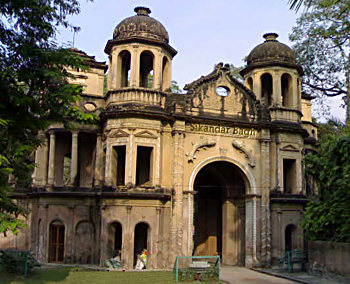
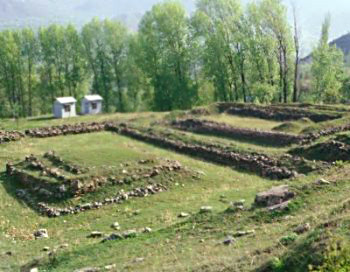
 Architecture of Kashmir shows the traces of various religious influences. The Buddhist, Hindu and Islamic religious beliefs have left an indelible mark on the architecture of the state. The earliest structural monuments in Kashmir include Buddhist remains at Harwan, Ushkur, Hutmur and Doonpather. These ancient structures can be traced back to the 1st and 6th centuries. The remains at Harwan reveal an apsidal temple with a courtyard, surrounded by a wall, a building complex, a Stupa, a chapel and other enclosures built in a diaper (patterned) pebble technique. At Ushkar are found the remains of a Stupa, a surrounding wall and a number of terracotta fragments. In the later centuries, huge constructions in stone replaced elementary mud and pebble structures.
After the construction of Buddhist sculptures in the early days, the 6th and 7th centuries saw the construction of Brahmanical temples. These temples symbolized a distinct aesthetic sensibility. The architecture consisted of trefoiled doorways covered by triangular pyramidal pediments and colonnaded cellular peristyles. Examples of this type can be seen in the temples at Martanda, Avantipur, Payar and the Pandrethan temple. Most of these temples face east or west, probably because of the sunlight, which symbolizes dynamism and the life giving principle.
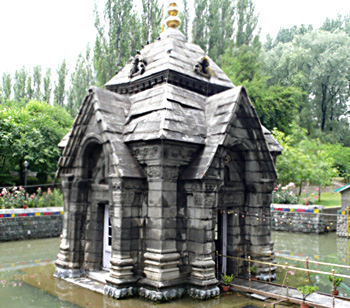 The temples at Payar, Pandrethan and Mansbal have straight pyramidal roofs in two tiers. These temples as well as the one at Narasthan have triangular pediments with trefoil niches on all four sides of the main shrine. The temples at Martenda, Avantipur and Buniyar have a cellular layout. They face a courtyard preceded by a colonnade with fluted pillars. The double-chambered gateway of each temple matches the central shrine in scale and design. The sculpture includes a unique four-faced image of Lord Vishnu (Vaikuntha), as well as Vasudeva- Lakshmi images which originated in Kashmir. Thus during the early phases, the architecture of the state reveals that the Brahmanical and Buddhist religions flourished side by side.
The fourteenth century saw the advent of Muslim rule in the region. The Islamic influence was seen in various spheres such as lifestyle, art and culture, religion etc. Architecture too, like all other aspects, underwent a marked change. Wood was now preferred to stone for the purposes of architectural construction. Elements of early architecture were blended and re-introduced in mosques and Muslim shrines. This can be seen in the Mosque of Shah Hamdan, the Jami mosque and the tomb and mosque of Madani.
With the coming of Mughal rule in the 16th and 17th centuries, further changes were added to the architecture of the region. The Mughal emperor Akbar added a massive stonefront in Srinagar on a hill overlooking the Dal Lake. Architectural constructions reached ite peak during the reign of the next two Mughal Emperors - Jahangir and Shah Jahan. Kashmir was called the paradise on earth, and a lot of effort was made to further beautify the place. A number of gardens were built during this time by royalty and nobility alike. One of the most famous gardens built during this time is the Shalimar Garden and Nishat garden. It was built during the reign of Shah Jahan. Set against the beautiful backdrop of the Pir Panjal Mountains, the entire garden is divided laterally by a wide stream that flows from the mountains behind and runs through a series of descending terraces. Pools with sprouting foundations and small pavilions embellish the garden.
The architecture of Kashmir is thus a fascinating blend of various religious influences.