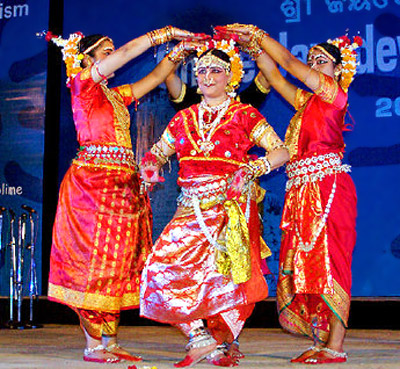
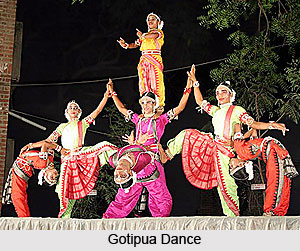
 Gotipua an Oriya etymon means a single boy; "goti" is single and "pua" is boy. A dance performed by a single boy dancer in female costume is known as Gotipua dance. When the dance of the Maharis slowly declined due to various reasons, the class of these boy dancers was created to carry out the tradition and it is largely from that the present form of Odissi dance has been revived. It is interesting to know that most of the present day Odissi gurus were Gotipua dancers in their youth.
Historical records reveal that most probably it is after Ramananda and Chaitanya that the Vaishnavas did not approve of dancing by women. They preached and practised the cult of Sakhi Bhava and introduced boy dancers in place of women. The boys dressed as girls began to dance in the temple precincts during the festivals. It was for the first time the temple dance came out of its home and began to be performed by the Gotipuas in public. At the same time it should be noted that the Gotipua dancers are never allowed to dance inside the temple. Only on some festive occasions they are specially allowed to perform in the temple precincts.
During the emergence of the Gotipua dancers the Vaishnava poets composed innumerable lyrics in votive dedication to Lord Krishna and the Vaishnava chose this dance of Gotipua as a medium of publicity of their cult and philosophy as the singing was done by the dancers themselves. Most of the Vaishnava Mathas of Orissa patronised the dancers and even some of them had their own groups to perform.
A Gotipua party consists of four or five members and the Guru always remains in charge of it. He also sings and plays on the harmonium. Other members are two accompanists they are a Mardala player and a Gini player and one or two boy dancers. All of them are paid by the Guru. They move throughout the state and their adjoining Oriya tracts of other states to earn their livelihood and solely depend upon public performance.
The dance of the Gotipuas is in Odissi style, but their technique, costume and above all presentation differ from that of the Maharis. The singing is done by the dancers themselves. The songs are generally the compositions of Vaishnava poets of Orissa on the dalliance of Radha and Krishna. On the occasion of certain religious festivals at Puri, such as Chandam Yatra and Jhulan Yatra their performance is considered indispensable till today. During the Jhulan Yatra most of the well known Gotipua parties assemble at Puri to perform at various religious centres. They are not allowed to perform inside the temples, but occasionally perform in the courtyards of certain shrines.
The most interesting item in Gotipua dance performance is Bandha Nritya. Though strictly not an item of Odissi it is still performed by the Gotipuas and few girl artists of Orissa. Bandha Nritya is a dance with acrobatic poses and movements. The difficult and intricate poses by the body with suppling of various limbs are known as Bandha in Oriya, so the dance with these poses is called Bandha Nritya.
During the closing years of the last century, the dance of the Gotipuas came to be much influenced by the decadent Sakhi Nacha of the southern districts of Orissa. The Sakhi Nacha which was also performed by boys in female costume was an imitation of the voluptuous dance of the devdasis who belonged to the adjoining Telugu regions. The Sakhi Nacha had a lasting influence on the dance of the Gotipuas.
In the present age the beauty and individuality of Gotipua dance have suffered to some extent because it has borrowed certain mannerisms associated with dancing in films.