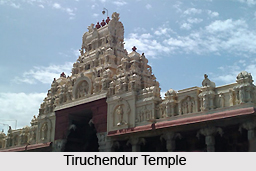
The temple of Tiruchendur is legendary. The main legend which is associated with the temple is with its principal deity that is Lord Muruga or Shanmukha or Subramanya. In fact it can be said that the temple has a Puranic account.
Once upon a time the Devas were harassed by the Asuras viz, the Demon Surapadman and his brothers. Devas appealed to
Lord Shiva in Kailash for deliverance. Six sparks of fire issued from the eye of Shiva, i.e., the central one between the two eye-brows, in answer to their prayers. These divine sparks were received by
Lord Agni, the God of Fire, and cast into the Ganges as he was unable to bear them. From the Ganges they passed into the Himalayan Lake Saravana Poigai. Here they were transformed into six babies suckled by six Krittika nymphs.
When
Parvati desired another child, besides Vinayaka, Lord Shiva promised to bless her with one more. He now showed her the Saravana Lake. Very much amazed at the sight of the six children, Parvati clasped all of them together. The result was that the six bodies became one but with six heads. That is why he is called Shanmuha, Shadanana and Arumuga, all meaning `six-faced`. He is also called Skanda. As he was reared by the six Krittika nymphs he was given the name Kartikeya. In the north, Muruga or Subrahmanya is known only by the name of
Lord Kartikeya.
Lord Muruga was made the general of the army of devas to release them from harassment by the demons. In order to free devas from the troubles of Surapadman, Karttikeya, and the son of Shiva, left Kailash and came to the South. He halted at Tiruchendur with his army to vanquish the demons those were entrenched in their sea-fort of Mahendragiri. As Mahendragiri was inside the sea near-about Tiruchendur, Lord Subrahmanya camped at Tiruchendur on the sea-shore.
Kartikeya desired to worship his father, Shiva. As there was no Shiva shrine there, Maya, the celestial architect, constructed the temple of Shiva in the sea front and Subrahmanya worshipped there. This is said to be the origin of this holy abode of Lord Kumara.
Each temple has its own sanctity. Yet there is difference in degree. This shrine of Tiruchendur is believed to be most liked by Subrahmanya and has been given the second place among His shrines in the Skandapuranam, the first being Palani.
According to the physiographical five-fold division of land, Muruga is assigned the hill country, Kurinji, and his shrines are invariably situated amidst mountains or forests as such places are dear to him. The deviation from the usual, in this case, is due to the mission that he undertook on behalf of devas.
Just as Surapadman was troubling devas in the South, another demon, named Tarakasura, brother of Surapadman was troubling them in the North. Muruga killed Tarakasura and had erected a pillar of victory (Sthamba) in commemoration of his success. Similarly the Tiruchendur temple also may be considered as a commemoration of the defeat of Surapadman in the south. From this camp at Tiruchendur, war started against Surapadman and his brother and it lasted for five days, when all the sons, the brother and the mighty hordes of the demon gave battle to Subrahmanya at sea, in the air and were finally vanquished.
On the sixth day, Surapadman alone survived. The Lord`s last bid to show the asura his grace was his Viswarupa Darsan. Demon Surapadman realised then the divinity of his enemy Muruga, but yet would not accept defeat. He continued his fight from region to region. Kartikeya took Indra as his vehicle in the form of a peacock and his lance, the Vel, sought the foe out of his hiding place in the ocean. At last Surapadman came out of his island fortress of Veera Mahendra, rose in the form of a terrible mango tree and attacked him. The lance of Kartikeya pierced the tree and broke it into two. The broken pieces instantly turned into a pea-fowl and a cock. It attacked Indra with no success. The demon would not yet accept defeat. But Shanmukha`s grace was so bountiful that, as an act of forgiveness, he took the pea-fowl as his permanent vehicle, relieved Indra of his duties and put the cock on his banner.
As Surapadman was a
Brahmin, the sin of Brahma Hatya affected Subrahmanya. He became pitch black in complexion and his beautiful shape was changed. As a result of this he prayed at Sikkal, took bath in the tank made out of the milk of Kamadhenu, the celestial Cow, and got back his original beautiful form and complexion. This is why Muruga is worshipped as Singaravelar at Sikkal in the Tanjore District.
Lord Muruga is known to have two consorts, Valli and Deivayanai. But in Northern India, Kartikeya is called Kumara or Bachelor God. He is fervently worshipped there as a heavenly boy with powers to confer heavenly gifts to his devotees. Hence is given the name of Balasubrahmanya.
The war against Surapadman and the success over him are celebrated every year at Tiruchendur on the days till Skanda Shashti i.e. the sixth day of the waxing moon in the Tula month (October-November). These six days are considered to be very sacred in the Hindu religious calendar. The Skandapurana is read at this time with devotion, in private houses and in the temple, with the hope of getting both material and spiritual benefits from Lord Skanda. Many devotees observe Nirjala fast on these days that are they do not drink even water.

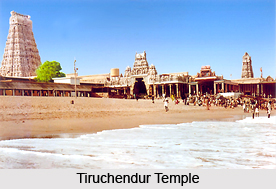 The Tiruchendur temple is the celebrated sea-shore temple of Lord Subrahmanya. It is situated in the Tiruchendur taluk of the Tirunelvedi District. The temple is on the shore of the Gulf of Mannar. The surging cool tides of the sea wash the foot of the temple. There is no other shrine in Chennai State, with such a beautiful natural setting. The origin of the temple dates back to the Puranic past. The main deity that is worshipped in the temple is Lord Muruga.
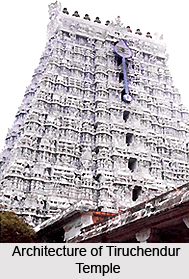 `Tiruchendur` means a sacred and prosperous town of victory. The temple was originally constructed on the sand-stone reefs of the beach, but due to corrosion by the sea, the stone began to disintegrate. Originally the temple was of a very modest construction, but during the course of about 1000 years many additions and alterations were made by different Pandya and Chera kings, their vassals, and the wealthy people of the locality, as a result of which the present gigantic structure has grown up.