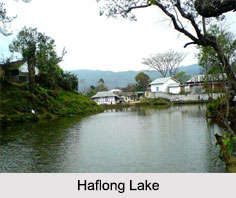
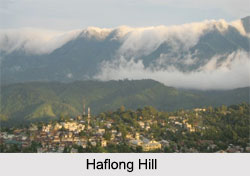
 Haflong town is the only hill station of Assam and the headquarters of Dima Hasao District (formerly known as North Cachar Hills). The word Haflong means ant hill in Dimasa language. While Shillong Hill is out of the state of Assam, a new hill emerges, at 680m height in Upper Haflong. It is the land of blue orchards and pera, pineapple and oranges. The nature of Haflong is a great attraction in itself along with the Haflong Lake situated within the heart of this hill town. Several ethnic groups including Dimasas, Hmars, Nagas and Mizos belonging to different religious denominations - Christian, Hindu and Buddhist live together here. Haflong has a humid subtropical climate.
Demography of Haflong
According to the 2011 India census Haflong had a population of 43,756, of which males are 45 percent and females are 55 percent. Average literacy of the town is 92 percent; male literacy is 85 percent and female 75 percent. Haflong has 12 percent of the population under 6 years of age.
Language of Haflong
Dimasa written in Bengali script is the most commonly spoken language. Bengali, Assamese and English languages are used as the medium of instruction. Haflong Hindi is used to communicate with people.
 Tourism in Haflong
Haflong has several tourist spots like Jatinga, Maibong, Umrangshu or Umrongso, Silchar, Haflong Lake, Haflong Hill etc. Several festivals are held in Haflong, which are equally popular like the tourist spots. The festivals are Behdeinkhlam Festival (celebrated in July), Laho Dance, and Chad Sukra (celebrated between April and May) etc. Some of the tourist spots have been discussed below:
Jatinga: 9-km south of Haflong on the Silchar road and covered with Blue Vandas Orchids, Jatinga is famed in local folklore as the place where birds commit mass suicide. The more brutal truth is that on certain foggy, moonless nights in autumn, local migrant birds can become disorientated while flying up the valley over the saddle of the hill and are attracted with lights by local people, who clobber them to death with bamboo poles and eat them. There is a bird watching centre in Jatinga, where one may be able to stay if one can get permission from the district forestry office in Haflong. Buses to Silchar pass through, but it may be easier to make a day-trip from Haflong by auto-rickshaw.
Maibong: 47-km away from Haflong, on the banks of river Mahur, there lies the ruins of the once flourishing capital of the Dimasa Kachari Kingdom. A stone house and temple of Kachari kings can be seen at Maibong.
Umrangshu or Umrongso:
112-km away from Haflong by road, the biggest Hydel plant under North East Electric Power Corporation (NEEPCO) has come up with dams across the river Kopili, a tributary of the Brahmaputra River. Near Umrangshu, there is a hot water spring Garampani, which is believed to possess medicinal properties.
Visiting Information to Haflong
The best time to visit Haflong is during the winter seasons- from October to February. Haflong is 84 km north of Silchar. New Haflong Railway Station and Kumbhirgram Airport are the nearest to visit this town. National Highway 27 connects Haflong to other places of Assam.