Music in early Bengali cinema was deeply rooted in
traditional themes and melodic frameworks. Renowned composers and music
directors of the era drew extensively from classical and folk idioms, creating
timeless compositions that blended sophistication with familiarity. These works
not only defined the music of early Bengali films but also continue to resonate
with audiences today.
Kamal Dasgupta: Kamal Dasgupta was a prominent
Bengali music director, lyricist, composer, and folk artist who was active in
both Hindi and Bengali cinema, particularly during pre-partition British India.
His musical style was deeply influenced by raga-based compositions and thumri,
which formed the core elements of his work. Over the course of his career, he
composed music for several cult classics in both Bengali and Hindi films. His
contributions to Bengali cinema include notable works such as Shesh Uttar
(1942), Garmil (1942), Malancha (1952), Sandhan (1953), Madhu Malati (1956),
Bodhu Baran (1967), among many others. In Hindi cinema, his musical legacy
includes films such as Megdoot (1945), Iran Ki Ek Raat (1949), Phulwari (1951),
and several more.
Nachiketa Ghosh:
Nachiketa Ghosh was an Indian music director known for his contributions
to Bengali, Hindi, and Oriya music. He composed memorable soundtracks for
several iconic films, leaving a lasting imprint on Indian cinema. Among the
notable movies for which he created music are Dhanyi Meye (1971), Stree (1972),
Nanigopaler Biye (1973), Mouchak (1974), Priyo Bandhabi (1975), Ananda Mela
(1976), along with many others.
Bhupen Hazarika: Bhupen Hazarika, widely known
as Sudha Kantha, was an Indian singer, songwriter, writer, filmmaker, and
politician from Assam. His musical and literary work was primarily rooted in
the Assamese language and was distinguished by themes of humanity and universal
brotherhood. Many of his songs were translated into other languages, most
notably Bengali and Hindi, allowing his message to reach a wider audience.
Centered on ideals of communal harmony, universal justice, and empathy, his
compositions gained timeless popularity across Assam, West Bengal, and
Bangladesh. In addition to his work as a lyricist and singer, he also served as
a music director for several films, including Mahut Bandhu Re, Chik Mik Bijuli,
Mon-Prajapati, Swikarokti, Siraj, and many others.
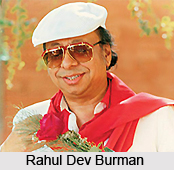
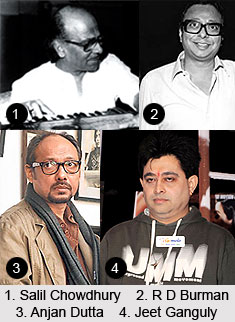
R. D. Burman: Rahul Dev Burman,
popularly known as R. D. Burman, was an Indian music director and singer widely
regarded as one of the most influential and successful composers in the Hindi
film music industry. Between the 1960s and the 1990s, he composed musical
scores for 331 films, introducing innovative orchestration and ensemble
techniques that transformed the soundscape of Indian cinema.
Burman collaborated extensively with legendary playback
singers such as Kishore Kumar, Lata Mangeshkar, Asha Bhosle, and Mohammed Rafi,
producing some of the most memorable songs of the era. He made his debut as a
music director with the Bengali film Rajkumari in 1970. His work in Bengali
cinema includes iconic films such as Troyee, Anyay Abichar, Ekanto Apon, Apon
Amar Apon, Lorai, Ahankar, Purushottam, Shraddhanjali, Birodh, among many
others.
Salil Chowdhury: Salil
Chowdhury was an Indian music director, songwriter, lyricist, writer,
and poet who composed predominantly for Bengali, Hindi, and Malayalam cinema,
while also contributing to films in a total of 13 languages. He made his debut
as a music director in Bengali cinema with Paribortan in 1949. His final
Bengali film, Mahabharati, released in 1994, marked the conclusion of his work
across 41 Bengali films. Renowned for his versatility and depth, Chowdhury
created memorable soundtracks for numerous iconic films, including Barjatri,
Pasher Bari, Aaj Sondhyay, Mohila Mahal, Ek Din Ratre, Bari Theke Paliye,
Gangaa, Lal Pathore, Paari, Sister, Sei Somoy, among many others.
Hemanta Mukherjee: Hemanta
Mukherjee, popularly known as Hemant Kumar, was an Indian music
director and playback singer who performed primarily in Bengali and Hindi,
while also lending his voice to songs in several other Indian languages. A
recipient of two National Film Awards for Best Male Playback Singer, he earned
the affectionate title of the “Voice of God” for his rich and emotive vocal
style.
In Bengali cinema, he made significant contributions as a
music director to several iconic films, including Jighansa (1951), Shapmochan
(1955), Surjatoran (1958), Deep Jwele Jaai (1959), Saptapadi (1961), Agun
(1962), Pratinidhi (1964), Parineeta (1969), Dadar Kirti (1980), Subarna Golak
(1981), among many others. He also composed memorable music for popular Hindi
films such as Anand Math (1952), Nagin (1954), Ek Hi Raasta (1956), Miss Mary
(1957), Bees Saal Baad (1962), Khamoshi (1969), Love in Canada (1979), and
several more.
Krishna Chandra Dey: Krishna Chandra Dey,
popularly known as K. C. Dey, was a distinguished Indian music director,
composer, musician, singer, actor, and music teacher, born in Calcutta (now
Kolkata). A pivotal figure in Indian music history, he is especially remembered
as the first musical teacher and mentor of S. D. Burman.
Dey’s career in cinema spanned from 1932 to 1946, during
which he made significant contributions as both a singer and a composer.
Alongside his musical work, he also appeared as an actor in films during the
same period. His work as a music composer includes notable films such as Shaher
Ka Jadoo (1934), Sonar Sansar (1936), Milap (1937), Purabi (1948), among many
others, leaving behind a lasting legacy in Indian film music.

Bappi Lahiri: Bappi
Lahiri, popularly known as Bappi Aparesh Lahiri and fondly referred to
as Bappi Da, was an Indian singer, composer, and record producer who
transformed the soundscape of Indian cinema by popularising synthesised disco
music. He often lent his own voice to his compositions and rose to prominence
during the 1980s and 1990s with a string of successful film soundtracks. Lahiri
delivered major box-office hits across Hindi, Telugu, and Bengali cinema,
establishing himself as a defining musical force of the era. His music
continued to find wide acceptance well into the 21st century. Among his iconic
works are films such as Zakhmee (1975), Disco Dancer (1982), Sharaabi (1984),
Sheesha (1986), Thanedaar (1990), Neelanjana (1994), Gunday (2014), Baaghi 3
(2020), and many others.
S. D. Burman: Sachin Dev Burman,
popularly known as S. D. Burman, was a celebrated Indian music director and
singer whose legacy left an indelible mark on Indian cinema. Born into the
royal family of Tripura, he began his artistic journey in 1937, composing music
for Bengali films. His distinctive style and deep understanding of melody soon
set him apart, paving the way for his transition into Hindi cinema.
As his career expanded, Burman emerged as one of the most
successful and influential composers in Indian film history. Over the decades,
he composed music for more than 100 films across both Bengali and Hindi cinema,
shaping the soundscape of an era. His work as a music director featured in
several iconic films, including Amar Geeti (1940), Shikari (1946), Baazi
(1951), Shahenshah (1953), Funtoosh (1956), Bewaqoof (1960), Jugnu (1973),
Phagun (1973), Mili (1975), and Tyaag (1977), among many others.
Shyamal Mitra: Shyamal Mitra was a distinguished
Indian playback singer, music director, and film producer whose contributions
left a lasting impact on both Hindi and Bengali cinema. Active across multiple
decades, he emerged as one of the prominent voices of the golden era of the
Bengali music industry. His work placed him among an illustrious group of
contemporaries that included Hemanta Mukherjee, Kishore Kumar, Manabendra
Mukhopadhyay, Manna Dey, and other celebrated Bengali singers of the time.
Beyond his achievements as a vocalist, Mitra earned wide
recognition as a composer, crafting memorable soundtracks that resonated with
audiences across generations. His work as a music director featured in several
notable films such as Lakh Taka (1953), Bhranti Bilas (1963), Rajkanya (1965),
Andha Atit (1972), Amanush (1974), Anand Ashram (1977), and Ekaki (1990), among
many others.
Sudhin Dasgupta: Sudhin
Dasgupta was a prolific Bengali music director, lyricist, and singer
whose creative vision significantly shaped the evolution of Bengali music.
While deeply rooted in the Bengali tradition, his artistic reach extended
beyond linguistic boundaries, as he also worked in Hindi, Assamese, and Oriya,
reflecting the versatility and breadth of his musical expression.
Dasgupta’s contributions opened new horizons for Bengali
music, influencing both the domain of Bengali modern songs and the soundscape
of Bengali cinema. His work as a composer and lyricist featured in numerous
acclaimed films, including Ulka (1957), Jatri (1960), Antaral (1965), Prothom
Kadam Phool (1970), Basanta Bilap (1973), Aparajita (1976), Amrita Kumbher
Sandhane (1982), and Banashree (1983), among many others.
V. Balsara: V. Balsara was an accomplished Indian
music arranger, conductor, orchestrator, and instrumentalist, widely admired
for his exceptional versatility across multiple instruments, including the
violin, mandolin, and piano. His technical mastery and adaptability made him a
valued presence in the early years of Indian cinema music.
He began his career in Hindi cinema in 1942 as an assistant
to Ustad Mushtaq Hossain on the film Badal. Balsara later went on to work
closely with Ghulam Haider, further refining his musical craft. In 1943, he
took on a more prominent role as one of the music directors for the film Circus
Girl. Over the course of his career, he contributed to approximately 35 Hindi
films as an assistant music director and independently composed music for about
a dozen Hindi films between the 1940s and 1950s, leaving behind a noteworthy
legacy in film music.
Mrinal Bannerjee: Mrinal Bannerjee was a multifaceted
music director, composer, lyricist, and vocal artiste whose name became
synonymous with melodious music. A well-known figure in the music and film
industry of West Bengal and India, he earned admiration from countless music
lovers both in the country and abroad for his enduring contributions. Born into
a family steeped in music, Bannerjee was immersed in the art from an early age.
As a boy, he often watched his father engage in rihaz of Hindustani classical
music and train aspiring learners, experiences that nurtured his deep-rooted
aspiration to enter the world of music. This early exposure shaped his artistic
sensibilities and laid the foundation for a lifelong musical journey.
Among his notable works was a modern Bengali song album
released under the Asha Audio label, beginning with Amon Sakaal Ami Dekhinito
Age, a composition based on the raga Ashir Bhairon, which received widespread
appreciation. Additionally, several songs originally made famous by the late S.
D. Burman were re-recorded in the voice of Mrinal Bandyopadhyay, and these
renditions continue to be cherished by listeners for their emotive depth and
musical authenticity.
Kalipada Sen: Kalipada Sen was a music director and
actor who made a significant and lasting contribution to Bengali cinema,
particularly during the 1950s, 1960s, and 1970s. As a composer, his work played
an important role in shaping the musical character of Bengali films during this
prolific period.
Among his most notable achievements as a music director were
the soundtracks for acclaimed films such as Sade Chuwattor (1953), Biraj Bou
(1972), and Binduor Chele (1973). In addition to these, Sen lent his musical
expertise to numerous other productions, including Devi Chaudhuri (1949),
Kulhara (1951), Kankavati Ghat (1955), Mahalagna (1963), Ram’s Sumati (1977),
Devdas (1979), Suvarnalata (1981), and Agradani (1983), among many others,
reinforcing his stature as a respected figure in the Bengali film industry.
Ramkumar Chatterjee: Ramkumar Chatterjee was an
eminent Bengali singer, composer, and music director, widely revered for his
mastery of classical music and his distinctive repertoire of Puratani (old
Bengali) songs, devotional compositions, and Tappa. His artistry was marked by
a deep respect for tradition, coupled with an inventive spirit that set him
apart in the world of Indian classical and semi-classical music.
A formative moment in Chatterjee’s career came when he
received the opportunity to accompany Kazi Nazrul Islam during a public meeting
organized by Subhash Chandra Bose in Kolkata. He later trained in Tappa under
Kolobabu, also known as Jitendranath Bandopadhyay, refining a style that would
become central to his musical identity. His professional journey gained
momentum when Sarat Chandra Pandit appointed him as a regular artist at
Akashbani Kolkata, a milestone that firmly established him as a professional
singer.
Chatterjee was particularly admired for his ability to
infuse traditional musical forms with subtle humor and quirky nuances, a skill
that resonated strongly with classical music connoisseurs. He earned widespread
popularity for his performances of Shyama Sangeet and Bengali Puratani songs,
also known as Baithaki Gaan. In addition to his contributions as a vocalist, he
composed music for two Bengali films, Strir Patra (1972) and Parikrama (1996),
and worked extensively as a playback singer in numerous Bengali films
throughout his career.
Anupam Ghatak: Anupam Ghatak was one of the most
influential composers in the history of Bengali music in India, with a
particularly strong presence in the world of cinema. Renowned for his evocative
and enduring compositions, he is best remembered for his work on the 1954
Bengali-language film Agni Pariksha, which remains a landmark in Bengali film
music.
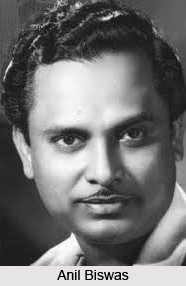
Anil Biswas: Anil
Biswas was a pioneering Indian film music director and playback singer
whose career spanned from 1935 to 1965. Widely regarded as one of the
architects of modern Indian film music, he played a crucial role in the early
development of playback singing. He is also credited with introducing the first
Indian orchestra comprising twelve musicians, as well as bringing orchestral
arrangements and rich choral effects into Indian cinema, innovations that
significantly transformed film music.
In recognition of his immense contribution to the performing
arts, Biswas was honored with the Sangeet Natak
Akademi Award in 1986. Over the course of his prolific career, he
composed music for numerous landmark films, including Dharam Ki Devi (1935),
Jagirdar (1937), Ek Hi Raasta (1939), Aurat (1940), Kismet (1943), Anokha Pyar
(1948), Tarana (1951), Pardesi (1957), Angulimaal (1960), and Chhoti Chhoti
Baatein (1965), among many others, leaving behind an enduring legacy in Indian
cinema.
Pankaj Mullick: Pankaj
Mullick, born Pankaj Kumar Mullick, was an Indian music composer,
playback singer, and actor who played a pioneering role in the evolution of
film music in both Bengali and Hindi cinema. Emerging at the advent of playback
singing, he was instrumental in shaping its early form and was also recognized
as one of the earliest exponents of Rabindra Sangeet in cinema.
As a music director, Mullick contributed to several landmark
films that helped define an era of Indian film music. His notable works include
Manzil (1936), Devdas (1936), Dushman (1939), Nartaki (1940), Dikshul (1943),
Manzoor (1949), and Raikama (1955), among many others, securing his legacy as a
foundational figure in Indian cinematic music.
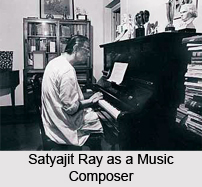
Satyajit Ray: Satyajit Ray was an
Indian film director, screenwriter, author, lyricist, magazine editor,
illustrator, calligrapher, and composer, widely regarded as one of the greatest
and most influential filmmakers in the history of world cinema. His
multifaceted creativity extended across literature, visual arts, and music,
making him a towering figure in Indian cultural history.
Beginning with Teen Kanya (1961), Ray composed the music for
almost all of his films, crafting distinctive scores that seamlessly blended
Western classical influences with Indian musical traditions. His approach to
film music was deeply thematic, enhancing narrative depth and emotional
resonance. Among his most notable musical works are Charulata (1964), Goopy
Gyne Bagha Byne (1969), Shatranj Ke Khilari (1977), Ghare Baire (1984), and his
final film Agantuk (1991), all of which stand as enduring testaments to his
artistic genius.