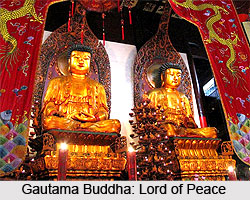
 Vesak or `Visakha` is an important day for the Buddhists and this is the day when Gautama Buddha`s birth, enlightenment or `Nirvana`, death or `Parinirvana` and his achievement of Nirvana are celebrated with a lot of fervor by Buddhists in the country and other nations like Bangladesh, Nepal, Bhutan, Tibet, Sri Lanka, Thailand, Singapore, Indonesia, Malaysia, Vietnam, etc. The appropriate date of celebration of Vesak differs as per the different lunar calendars, and it is observed on a full moon day or `Uposatha` day, corresponding to the 5th and 6th lunar month in Theravada nations which follow the Buddhist calendar. A full moon day is chosen because the legends say that Mayadevi, Buddha`s mother, gave birth to him in Lumbini on such a day.
However, in case of leap years this Buddhist festival is observed in the month of June, instead of the usual time of its celebration during the month of May. The term `Vesaka` is a derivation of `Vesakha` which is a Pali word implying the name of a lunar month represented by the period between April and May. It is known as `Vesak` in Sinhala, `Araw Ni Buddha` in Filipino, `Fo Dan` in Chinese, `Buddha Jayanti` or `Buddha Purnima` in Nepali, `Hari Waisak` in Indonesian, `Budhho Purnima` or `Budhho Joyonti` in Bengali, `Saga Dawa` in Tibetan, `Wisakha Bucha` in Thai, `Hanamatsuri` in Japanese, `Hari Wesak` in Malaysian and so on. History of Vesak
The decision to observe Vesakha as the birthday of Lord Buddha was officially declared in the year 1950, at the conference of World Fellowship of Buddhists conducted in Sri Lanka. With the spread of Buddhism to the other portions of the world from India, it was embraced by different cultures and started to be celebrated in diverse procedures throughout the world. The United Nations decided to observe the day of Vesak, officially at its offices and headquarters in 1999.
Rituals of Vesak
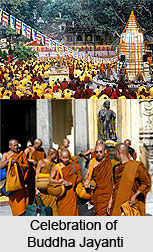
On the auspicious day of Vesak, dedicated Buddhists and followers of this faith congregate at different temples prior to dawn for the purpose of participating in the hoisting of Buddhist flag and singing Buddhist hymns. The hymns are dedicated to the `Dharma`, `The Buddha` and `The Sangha`, which are said to be the holy `Triple Gem`. Devotees are allowed to bring simple offerings like flowers, incense sticks and joss sticks. This special act is performed to remind mankind that man is immortal and are subject to their ultimate destination, which is decay and death, just like the candles or incense sticks, which finally blow out. On this holy day various Buddhist places also release birds, insects and animals as a symbolic act of liberation. The devotees listen to the preaching by the monks.
Devotees follow a vegetarian diet during that day in order to prevent the killing of any living creatures. Another remarkable aspect of Vesak is that on this special day efforts are made to bring happiness to the poor, aged, sick and handicapped. The Eightfold Principles of Buddha are once more presented before the world. It is that time of the year when devotees need to remind themselves about these principles and live up to them and are clad in white attires, after which they spend the day in temples. A small idol of Lord Buddha is placed in front of the altar in a few Buddhist temples, near a tiny basin filled with water and adorned with flowers. Devotees are permitted to pour water over this sacred idol, which symbolises the purification of themselves from all their sins and bad `karma` and re-enactment of the celestial events which occurred following the birth of Gautama Buddha, when heavenly offering were bestowed upon Buddha by spirits and `Devas` from the heavens.
The core reason to celebrate Vesak is to propagate love, peace and universal brotherhood. To live in peace it is important to free one`s mind of the defilements and Vesak is the right time to make a resolution for creating a better world by following Buddha`s principles.