 Chandogya Upanishad is the part of Chandogya Brahaman and is associated with Sama Veda. It is ranked ninth in the Muktika canon of hundred and eight Upanishadas. The Chandogya Upanishad depicts the importance and greatness of universal holy syllable `Om Mantra` and the significance of vital life force or `Prana`. Chandogya Upanishad contains ten chapters. The 17th Khanda of Chapter Three of Chandogya Upanishad deals with the sacrifice of man. It is an extension of the 16th Khanda of chapter three of Chandogya Upanishad. This khanda divides man into different categories on the basis of their actions. According to it when a feels hungry, thirsty and abstains from pleasures, it is known as his initiatory rites. Next when he eats drinks and enjoys pleasures, he then takes part in Upasadas. When a man laughs, eats and enjoys sexual intercourse it is known as Stuta and Sastra. A man`s life is a sacrifice His penance, charity, sincerity, non violence and truthfulness constitute his reward or dakshina. It is thus, said at the birth of a child that the mother has given birth to a child. The same words are used during the Soma sacrifice. His avabhritha i.e. the death is the termination, so is the termination of the sacrifice called avabhritha.
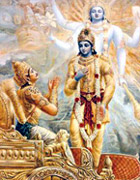
Ghora, the son of Angira, had given a detained explanation about this subject to Lord Krishna, the son of Devaki and Vasudev. He told him that at the time of death a man must recite three mantras of the Yajur Veda. He must say that the Supreme Brahman is indestructible i.e. akshata and does not decay. He also does not change i.e. aprachyuta. There are two stanzas about this in the Rig Veda. According to it the person who is aware and realises it as the Supreme Brahman or the real Self can see the Supreme Light spread in all the corners. It shines in Brahman, which is all pervading like the light of day. The Brhaman is a part of the primeval seed.
Having beheld that exquisite light, as high above all darkness of ignorance, and having beheld it also in his own heart he perceives that is the Supreme Light which is higher than all lights, he attains to that god of gods and noblest of all lights, the sun, the most luminous of all lights and gods.