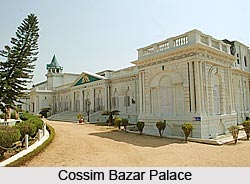
Cossimbazar

Cossimbazar is a census town that is situated in the Murshidabad district of West Bengal state. The suburb city of Cossimbazar was once the city of royal palaces.

Introduction

Cossimbazar, Murshidabad District, West BengalCossimbazar which is also known as Kasimbazar is a census town in Murshidabad District of West Bengal. Numerous towns and cities have developed in the states of Indian continent. Amongst several towns one can easily distinguish the significance of Kasim Bazar. It is an example of census town lying in the district of Murshidabad of West Bengal state.

Location of Cossimbazar

The later medieval and the modern town of Cossimbazar is located on the river Bhagirathi in the Murshidabad district of West Bengal. Cossimbazar is included in the Berhampore Municipality. In the year 1901 the population of Cossimbazar was just 1,262. Cossimbazar is located at 24.12 degree north to 88.28 degree east. It has an average elevation of 17 metres (56 feet).

History of Cossimbazar

History of CossimbazarHistory of Cossimbazar can be traced back with the beginning of the 16th Century. Though with the beginning of the 17th Century, Bengal Sultanate began to flourish in the hands of Murshid Quli Jafar Khan and Alivardi Khan, later the Sultanate declined in the hands of British East India Company during the rule of Siraj ud daullah in the Battle of Plassey (1757).

It was the matter of great importance when Murshidabad (now Murshidabad District) was established by the Bengal Sultanates. For the first time, European traders like the traders of French East India Company and British East India Company set up factories in Cossimbazar or Kasim bazaar. From that time onwards, it became the prominent place in Bengal. After the ruins of Satgaon by the silting up of the mouth of the Saraswati River it gained a position, as the great trading centre of undivided medieval Bengal, which was not challenged until after the foundation of Calcutta or Kolkata (combination of three villages namely Govindapur, Sutanati and Kalikata).

In the year 1658, the first English agent of British East India Company was established at Cossimbazar, and in 1667 the chief of the factory there became an ex officio member of council. Cossim bazaar became the prominent place in business of later medieval era.

History of Cossimbazar In English documents of this period, and till the early 19th century, the Bhagirathi River was described as the "Cossimbazar river", and the triangular piece of land between the Bhagirathi River, Padma River and Jalangi River, on which the city stands, as the island of Cossimbazar or Kasimbazar.

The proximity of the factory to Murshidabad, the capital of the Independent Nawabs of Bengal, while it was the main source of its wealth and of its political importance, exposed it to a constant risk of attack. Thus in 1757 it was the first East India Company factory to be taken by Siraj-ud-dowlah, the last Independent Nawab of Bengal; and the resident with his assistant Warren Hastings were taken as prisoners to Murshidabad.

At the beginning of the 19th century the city of Cossimbazar still flourished; as late as 1811 it was described as famous for its silks, hosiery, koras and beautiful ivory work. However, its once healthy climate of Cossimbazar gradually worsened and probably because of endemic malaria, the area of cultivated land round it shrank drastically.

The jungles of Cossimbazar took its place, and in 1813 its ruin was completed by a sudden change in the course of the Bhagirathi River. A new channel formed 3 miles from the old town, leaving an evil-smelling swamp around the ancient wharves. Of its splendid buildings the fine palace of the Maharaja of Cossimbazar alone remained, the rest being in ruins or represented only by great mounds of earth. The first wife of Warren Hastings was buried at Cossimbazar, where her tomb with its inscription still remained in the early 20th century. Now, the tomb of Lady Warren Hasting is one of the most important tourist attractions along with Cossimbazar Palace.

Demography of Cossimbazar

Following the trend of India the eminent demographers also have carried on surveys and research works with the purpose of throwing some light on the demographical scenario of Kasim Bazar. As a result of their diligent services they have been able to prepare extensive reports on the basis of data that they gathered. According to the Population Census of 2011, Cossimbazar which is also known as Kasimbazar had a population of 10,175. The males constitute 52 percent of the population and females 48 percent. Kasim Bazar has an average literacy rate of 78 percent, which is higher than the national average of 59.5 percent. The male literacy rate is 83 percent and female literacy is 72 percent. In Kasim Bazar, 9 percent of the population is under 6 years of age.

Education of Cossimbazar

The literacy rate of Cossimbazar or Kasimbazar is a yardstick, which helps one to gauge the development and progress of a particular once royal town. In case of Kasim Bazar or Cossimbazar also the same rule is applicable. From the report, the average literacy rate of Kasim Bazar has been measured to be 78 percent.
Recently updated articles in Cities of India

Deoghar in Jharkhand
Deoghar in Jharkhand Thumbnail

Deoghar in Jharkhand

Deoghar is the divisional headquarters of Santhal Parganas located in Jharkhand and is popular for the famous Baidyanath temple and Shiva Temples.

The Asiatic Society of Mumbai
The Asiatic Society of Mumbai Thumbnail

The Asiatic Society of Mumbai

Asiatic Society in Mumbai is the temple of Asian Studies from the time of British rule in India.

Vasco da Gama / Vasco City
Vasco da Gama / Vasco City Thumbnail

Vasco da Gama / Vasco City

Vasco da Gama / Vasco is the biggest city of Goa and is one of the most visited for its perfect amalgamation of business as well as leisure options.

Agriculture of Ladakh
Agriculture of Ladakh Thumbnail

Agriculture of Ladakh

Agriculture in Ladakh is primarily practiced in the short summer season due to its cold desert climate. Farmers grow hardy crops like barley, wheat, p...